
Nov. 13, 2026
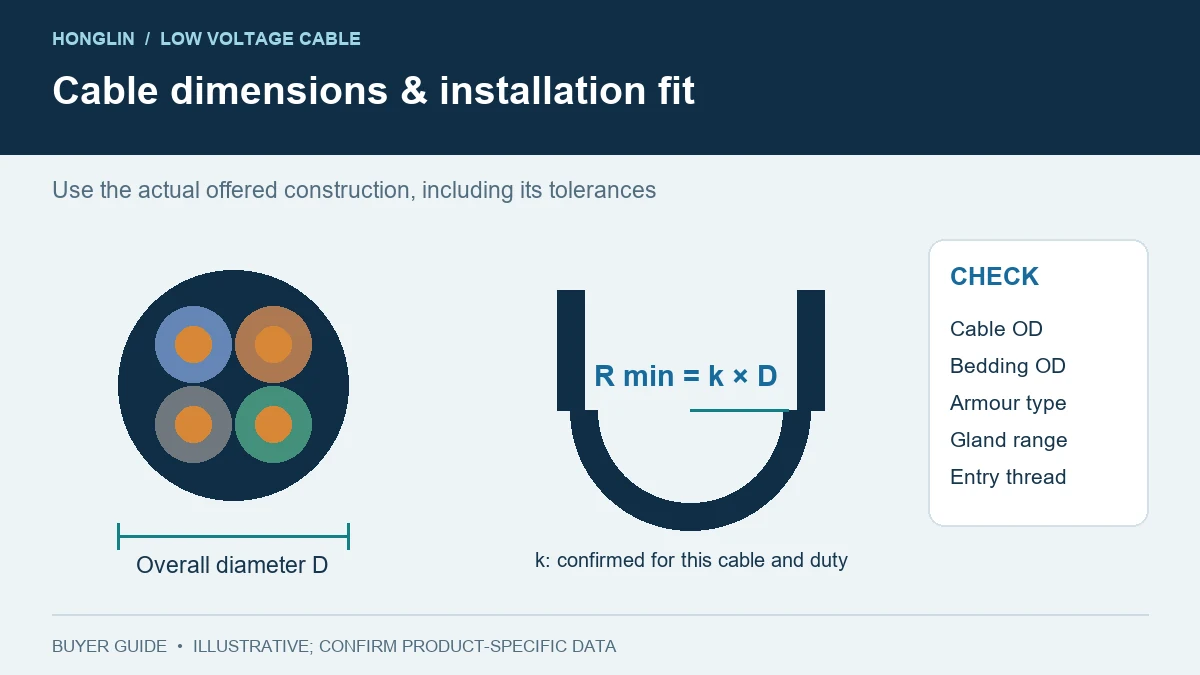
The low voltage cable outer diameter is an installation-interface dimension. It helps the project team review entry openings, gland compatibility and available space. The low voltage cable minimum bending radius is a separate product requirement that must be confirmed for the actual cable construction and installation duty.
Two low voltage cable offers can have the same conductor area and different overall dimensions. The complete construction includes insulation, bedding, armour where applicable and the outer sheath. Obtain the offered product drawing before finalising the surrounding hardware.
Ask whether the stated value is nominal, approximate or a specified maximum, and request the applicable tolerance where needed for an interface check. A nominal catalogue dimension may be useful for initial planning, but a close-fitting entry needs the dimensional range accepted by the accessory manufacturer.
| Interface | Cable information to request | Confirmation needed |
|---|---|---|
| Outer seal or entry | Overall diameter and applicable range | Compatible sealing range and entry arrangement |
| Armoured gland | Armour type and relevant bedding/armour dimensions | Compatibility with the actual cable construction |
| Constrained route | Overall dimensions and bending requirements | Clearance for the planned installation method |
| Equipment connection | Conductor material, class, shape and area | Suitable terminal or lug system |
| Installation handling | Manufacturer's applicable handling and pulling instructions | Installer's approved method and equipment |

Keep the low voltage cable outer diameter attached to the exact product reference and revision. If a supplier changes the armour or sheath construction, repeat the interface review instead of carrying the old dimension into the revised purchase order.
Manufacturers commonly express a minimum bend radius as a multiple of the cable's overall dimension. Eland's explanation identifies construction, conductor and material factors that affect the requirement. The multiplier must come from the applicable product information, not from a universal rule for all XLPE or armoured cables.
Confirm the low voltage cable minimum bending radius for the condition being assessed. Ask whether the instruction applies during installation, in the final fixed position or under another defined duty, and how the radius is measured. If separate values or conditions are provided, keep them separate in the installation review.
The accompanying drawing shows only the relationship R = k × D. It deliberately gives no universal value for k. A radius and a diameter are different quantities; the installer must use the measurement convention in the applicable instructions when checking a proposed bend.
The low voltage cable outer diameter is a starting input, but an armoured gland review may need additional dimensions and construction details. Eland's selection guidance discusses cable construction, environment, bedding, armour and the equipment connection. Have the accessory manufacturer confirm compatibility with the offered cable and installation conditions.
For purchasing, record the cable drawing reference alongside the accessory proposal. If the gland, thread or entry arrangement changes, make the responsibility for that interface explicit. A supplier's cable quotation does not automatically include confirmation of every third-party enclosure or accessory.
A cable fitting through an opening does not establish adequate ampacity, voltage drop or short-circuit performance. Equally, an electrically acceptable size can still require a different mechanical arrangement. The low voltage cable buyer should keep both reviews visible in the approval schedule.
Use our sizing and voltage-drop input guide for the electrical side. For the installation side, submit the relevant route drawing, offered cable dimensions and accessory references to the responsible designer or installer.
Before accepting a substitution, recheck the low voltage cable minimum bending radius and the dimensions that affect the route. A change that appears minor in the BOQ may require a different entry plate, accessory or installation sequence. Make any resulting costs and programme effects part of the comparison.
Do not assume so. Confirm the actual construction and dimensional range with the gland supplier. The conductor-area description alone does not describe the complete cable interface.
Some catalogue data is intended for general planning. Ask for the appropriate dimensional limits or tolerances when the value is needed for an accessory or equipment fit.
No. Use the manufacturer's instruction and applicable specification for the offered construction and duty. Do not transfer a factor from another cable merely because its voltage rating is the same.
Send the cable schedule, installation arrangement, available space, equipment entry details and proposed accessories. State which values are already approved and which interfaces still need confirmation.
Send Honglin Cable your BOQ or data sheet, rated voltage, core sizes, conductor material, insulation, sheath and armour requirements, lengths, destination and required documents. Identify any open approval or installation questions. Product availability, evidence, packing options and delivery terms must be confirmed for the enquiry.
Send your specification for review and quotation or browse our 0.6/1kV low voltage power cable range.


