Nov. 13, 2026
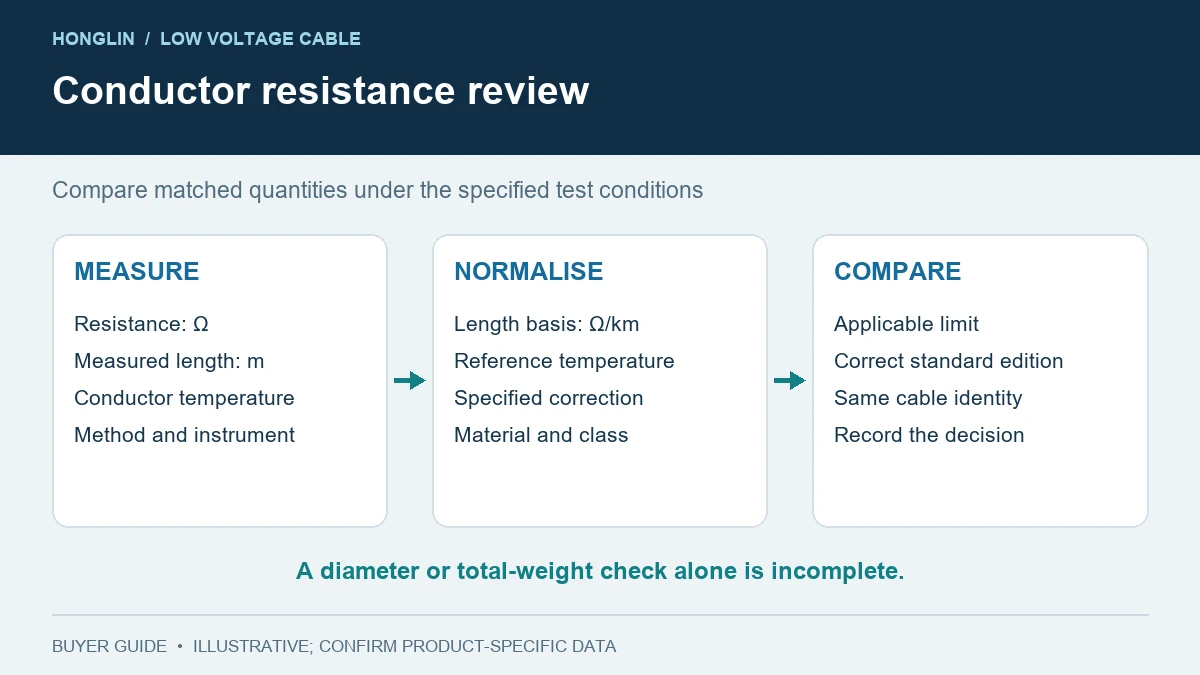
A low voltage cable conductor resistance test provides an electrical measurement that must be interpreted against the correct conductor requirements. The result needs a defined length basis, temperature basis, material, class and nominal area. Comparing two unqualified numbers can produce the wrong conclusion even when both reports describe the same nominal cable size.
For a low voltage cable buyer, the practical task is to request a traceable report and check that the result and limit refer to the same specification. This guide explains the information to review; measurements should be carried out by competent personnel using the applicable procedure and suitable equipment.
The report should connect the tested item to the supplied product and identify the conditions used to obtain and express the result. Request the following information before deciding whether the evidence is complete.
| Report field | Why it matters | Buyer question |
|---|---|---|
| Cable and sample identity | Links the result to the offered or delivered construction | Which product, batch or drum does the record cover? |
| Conductor description | Determines the relevant requirement | What material, class and nominal area were tested? |
| Measured length | Allows the measured resistance to be expressed per unit length | What length was used and how was it established? |
| Temperature basis | Allows comparison at the specified reference condition | What was measured and what correction was applied? |
| Units and result | Prevents comparison of unlike quantities | Is this measured resistance or a normalised Ω/km value? |
| Acceptance basis | Identifies the limit being applied | Which standard edition, requirement and value apply? |
| Method and equipment | Supports a review of measurement validity | Is the method identified and the equipment status appropriate? |

IEC 60228:2023 covers conductors of insulated cables. Use the edition and requirements specified for the project rather than assuming that any report carrying “IEC” in its title is sufficient. The responsible technical reviewer should confirm the correct acceptance basis.
A low voltage cable conductor resistance test may record the measured resistance of a length and then express a result per kilometre at a specified reference temperature. These are related quantities, but they are not interchangeable. A longer conductor can have a higher measured resistance without having a higher resistance per unit length.
For a simple length conversion at the same temperature, a measured resistance R over length L metres corresponds to R × 1000 / L in Ω/km. Temperature correction is a separate step and must use the applicable procedure for the conductor concerned. Do not apply a copied correction factor without confirming its basis.
Check whether the report already states the corrected value before applying any further calculation. Record both the reported result and the applicable limit with their units. If an acceptance decision is close to a limit or the method is unclear, refer the issue to the technical reviewer and testing party rather than changing rounding until it passes.
The low voltage cable conductor resistance test addresses an electrical characteristic. An outside-diameter check and a total-cable weight check include other construction features and answer different questions. They may reveal a discrepancy worth investigating, but neither alone establishes conductor compliance.
Nexans explains that nominal conductor cross-section is linked to defined conductor requirements, including resistance. It also explains why a geometrical measurement can differ from the nominal designation. Do not turn an informal diameter calculation into an automatic accusation of an undersized or defective product.
For a low voltage cable shipment, combine the approved construction, required measurements and relevant document checks. If the product differs from the order, identify that difference precisely. A general claim that “the cable feels light” gives the supplier little basis for investigation.
A passing low voltage cable conductor resistance test does not prove every aspect of insulation, sheath, armour, fire performance or suitability for the intended route. Ask for the evidence required by the actual cable specification. Our test-report guide explains how to separate the documents needed for purchasing.
Where a record is missing or inconsistent, request clarification with the cable item, report number and relevant batch or drum reference. Keep the item under the project's agreed review procedure until the discrepancy is resolved. Any additional measurement should follow an approved method on appropriately isolated equipment or samples.
No. Confirm the applicable requirement for the conductor material, class and nominal size. Comparing different materials against one copied value can invalidate the assessment.
It supplies one relevant conductor characteristic, but it does not by itself determine the current rating of an installed circuit. Construction, installation conditions and the design assessment still matter.
A useful assessment needs an appropriate method, equipment, sample length, temperature basis and acceptance criterion. Agree the review procedure with the responsible technical parties before treating an informal measurement as a final result.
Identify the conductor requirements and the evidence expected with the order. Send the project specification and ask the supplier to confirm the available product-specific documentation and any unresolved points.
Send Honglin Cable your BOQ or data sheet, rated voltage, core sizes, conductor material, insulation, sheath and armour requirements, lengths, destination and required documents. Identify any open approval or installation questions. Product availability, evidence, packing options and delivery terms must be confirmed for the enquiry.
Send your specification for review and quotation or browse our 0.6/1kV low voltage power cable range.
Previous post:
None