
Nov. 13, 2026
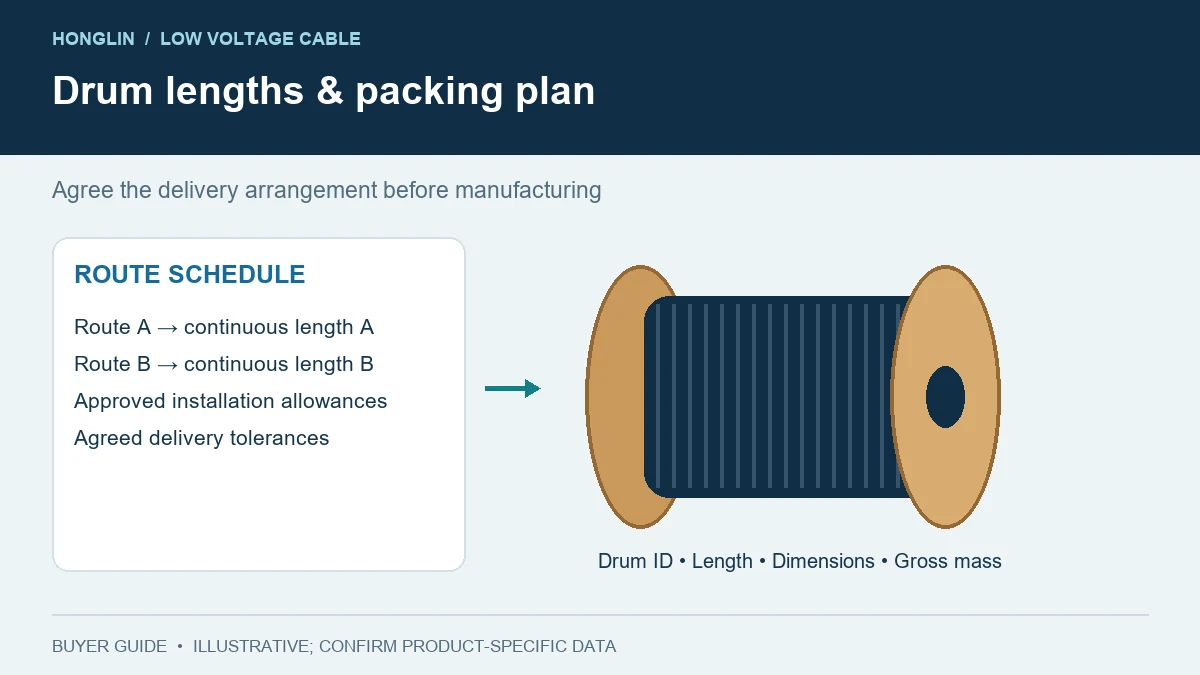
Agreeing the low voltage cable drum length before production helps the buyer connect the manufacturing plan to the installation routes. The total number of metres is only one part of the order. A workable low voltage cable drum packing plan also identifies the drum arrangement, dimensions, gross mass, labels and delivery conditions.
For exported low voltage cable, this information supports several decisions at once: how the supplier allocates continuous lengths, how the shipment is handled and how the receiving team identifies each circuit. Confirm the arrangement with the supplier and project team before assuming that any combination of drums will suit the site.
Prepare a schedule showing each cable item, route reference and required continuous length. The project team should include approved installation allowances and identify whether joints are permitted. Do not divide the total ordered quantity into convenient drum sizes without checking whether the resulting lengths can serve the routes.
For example, three routes may need three separately identified continuous lengths even when all use the same cable construction. This is a planning example, not a standard drum-size rule. Ask the supplier to propose a drum allocation and clearly flag any production or transport constraints.
| Schedule field | Buyer input | Supplier confirmation |
|---|---|---|
| Cable item | Approved product reference and construction | Offered drawing or data revision |
| Route and continuous length | Required circuit lengths and allowances | Proposed length per drum |
| Quantity basis | Total required length and acceptable delivery arrangement | Number of drums and total supplied length |
| Tolerance | Project acceptance and billing requirements | Agreed measurement and tolerance terms |
| Physical package | Receiving and handling constraints | Drum dimensions, gross mass and protective arrangement |
| Identification | Project and destination references | Drum label, cable marking and packing-list format |

The agreed low voltage cable drum length should appear in the order documents and packing schedule. If the required continuous length changes, ask for an updated arrangement before releasing the revised order. Check whether that change affects production, shipment or the installation sequence.
A drum that is suitable for shipment can still create difficulties at a site with restricted access or limited handling equipment. Give the supplier the relevant receiving constraints early. Request the dimensions and gross mass for the proposed package, rather than using values from an unrelated catalogue photograph.
Eland's drum-size guidance shows that drums have different dimensions and weights. The actual package must be confirmed for the offered cable and length. Do not infer a container loading quantity from cable metres alone.
The low voltage cable drum packing review should also address the planned storage period, environmental exposure and protection of the cable ends and accessible surfaces. Ask the manufacturer for the storage and handling instructions applicable to the delivered package. Where destination requirements affect wooden packaging, have the responsible logistics parties confirm what is required for that shipment.
A statement such as “standard tolerance applies” leaves room for different interpretations. Record the agreed low voltage cable drum length, acceptable variation, measurement basis and treatment of supplied quantity in the commercial documents. A short delivery can matter greatly when one route requires an uninterrupted length.
Keep production length, supplied length and usable route length distinct in the schedule. The project designer or installer should approve route allowances; the supplier should confirm the offered delivery lengths. If alternatives are necessary, review them before manufacturing instead of leaving the receiving team to resolve them after arrival.
The low voltage cable drum packing list should connect drum IDs to cable items, lengths, dimensions and gross mass. Where the shipment is split, identify which documents and order lines belong to each delivery. The receiving team can then check completeness without relying on a general shipment total.
Handling must follow a suitable plan and manufacturer instructions. Eland's handling guidance emphasises load-appropriate equipment and protection against unwanted movement during transport. This procurement schedule provides the required package information; it does not replace a site lifting assessment.
Submit the required continuous lengths for review. The supplier needs to confirm manufacturing and packaging feasibility for the cable concerned. Do not assume an unlimited continuous length or an immediately available drum size.
Provide the cable schedule, route lengths, destination, handling constraints, storage expectations and required label references. Ask for the proposed drum count, package dimensions and gross mass with the offer.
That may be an option if the project team approves the cutting, handling and traceability arrangements. Compare it with individually allocated drums before deciding; either approach has practical implications for receiving and installation.
Use a consistent scope and quantity basis. Confirm the supplied lengths and any packing or delivery charges, then compare the complete offer. Our cable-price guide explains the wider quotation comparison.
Send Honglin Cable your BOQ or data sheet, rated voltage, core sizes, conductor material, insulation, sheath and armour requirements, lengths, destination and required documents. Identify any open approval or installation questions. Product availability, evidence, packing options and delivery terms must be confirmed for the enquiry.
Send your specification for review and quotation or browse our 0.6/1kV low voltage power cable range.
Next chapter:
Class 2 vs Class 5 Conductors in Low Voltage Power Cable


