
Nov. 13, 2026
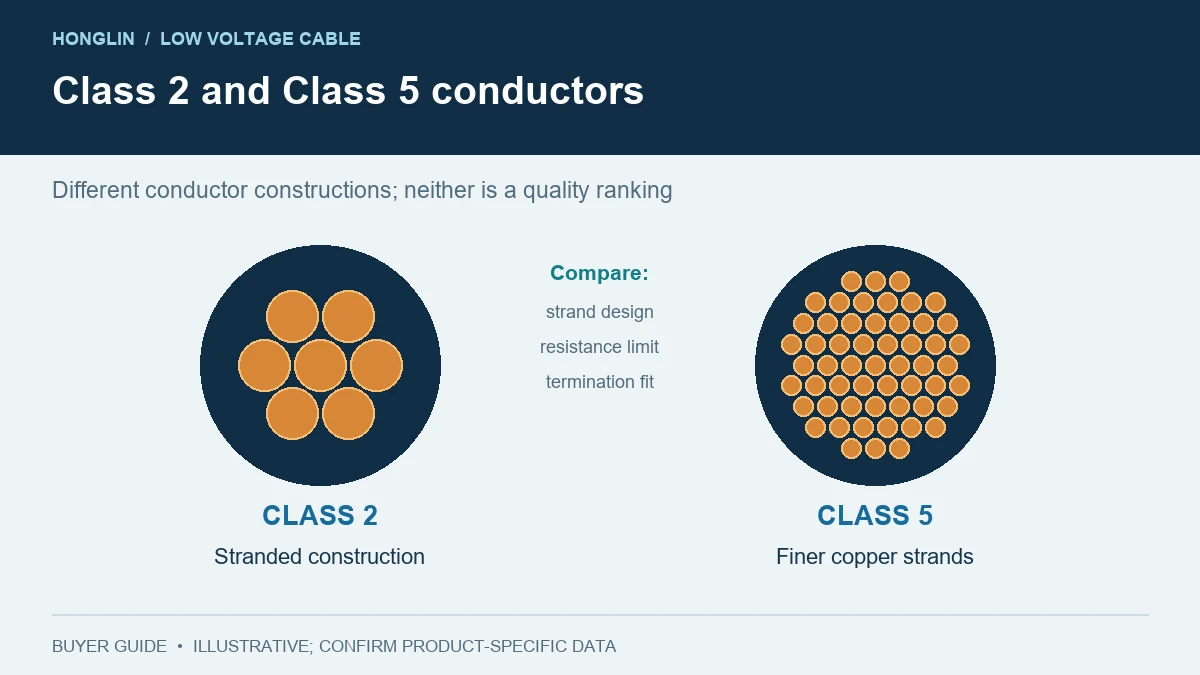
A Class 2 vs Class 5 power cable conductor comparison concerns conductor construction and its requirements, rather than a simple quality ranking. For a low voltage cable order, specify the required material, class, nominal area and connection system together. A more flexible conductor is not automatically a suitable replacement for the construction already approved by the project.
Class 2 describes stranded conductors; Class 5 describes flexible copper conductors built with finer wires. Nexans explains the conductor classes and their resistance-related requirements. Its guidance also notes that IEC 60228 does not define aluminium Class 5 and Class 6 in the same way as flexible copper conductors. Confirm the actual standard scope before accepting a loosely worded description.
Ask why a particular class is requested. The reason may relate to the approved cable specification, available installation space or the connection arrangement. Identify that reason before comparing supplier prices. An offer that simply says “stranded copper” leaves an important part of the low voltage cable description unresolved.
| Comparison point | What the buyer should establish | What not to assume |
|---|---|---|
| Conductor description | Material, class, nominal area and applicable standard | A higher class number means a higher quality grade |
| Wire arrangement | The construction required for the identified class and size | One photograph establishes the complete specification |
| Electrical requirement | The resistance requirement for that material and class | Different classes have an identical acceptance limit |
| Termination | Lug or terminal compatibility and the approved installation system | The same cross-section label guarantees the same connection fit |
| Complete cable | Overall construction, dimensions and manufacturer instructions | Flexible strands prove the entire cable is suitable for continuous movement |

The current IEC 60228 publication addresses conductors of insulated cables. For a purchase order, state the edition required by the project and have the technical reviewer confirm the applicable provisions. A catalogue mention of a standard is not a substitute for the required product evidence.
A useful Class 2 vs Class 5 power cable conductor review includes the accessory supplier or panel builder. Provide the conductor material, class, shape and size, together with the proposed cable reference. Ask for the compatible terminal or lug and the relevant installation instructions.
For the low voltage cable buyer, the commercial question is whether a proposed substitution creates extra work elsewhere. It may require a different connector, revised documentation or a new installation review. Keep those costs visible in the alternative offer rather than comparing only the cable price per metre.
Do not improvise a termination arrangement from a photograph. The installer needs the approved connection system, preparation method and tooling specified by the responsible manufacturer. Written confirmation is particularly useful when the original equipment specification names a specific conductor class.
The overall low voltage cable contains more than its conductor. Insulation, sheath, armour and the assembled construction also affect how the product can be handled and installed. A flexible conductor description alone does not establish a cable's suitability for drag chains, repeated flexing or a particular bend.
In a Class 2 vs Class 5 power cable conductor comparison, obtain the complete product data for both options. If the intended duty includes movement, vibration or constrained installation, describe those conditions explicitly and ask for a product-specific suitability assessment. Avoid replacing the approved construction based only on the ease of bending a short sample by hand.
Keep Option A as the specified construction. Identify Option B as the proposed alternative, stating every changed field. For each option request the low voltage cable data sheet, conductor specification, dimensions, relevant evidence and commercial terms. The project reviewer can then approve or reject the difference without losing track of the original requirement.
Our copper-versus-aluminium guide addresses a separate material decision. Do not combine a change of material, class and cross-section into an unexplained “equivalent” replacement.
No. Select the construction that meets the project and connection requirements. The class label describes specified characteristics; it is not a ranking of supplier quality.
Only after the proposed low voltage cable and its connections have been reviewed against the project requirements. Matching the nominal area does not close every electrical, mechanical or installation question.
Request both product data sheets, the applicable conductor requirement, resistance information, dimensional data and accessory compatibility confirmation. List deviations in the quotation.
Visual inspection may help identify the construction, but it is not a complete compliance assessment. Use the applicable standard, manufacturer data and required measurements rather than a strand count alone.
Send Honglin Cable your BOQ or data sheet, rated voltage, core sizes, conductor material, insulation, sheath and armour requirements, lengths, destination and required documents. Identify any open approval or installation questions. Product availability, evidence, packing options and delivery terms must be confirmed for the enquiry.
Send your specification for review and quotation or browse our 0.6/1kV low voltage power cable range.


