Nov. 13, 2026
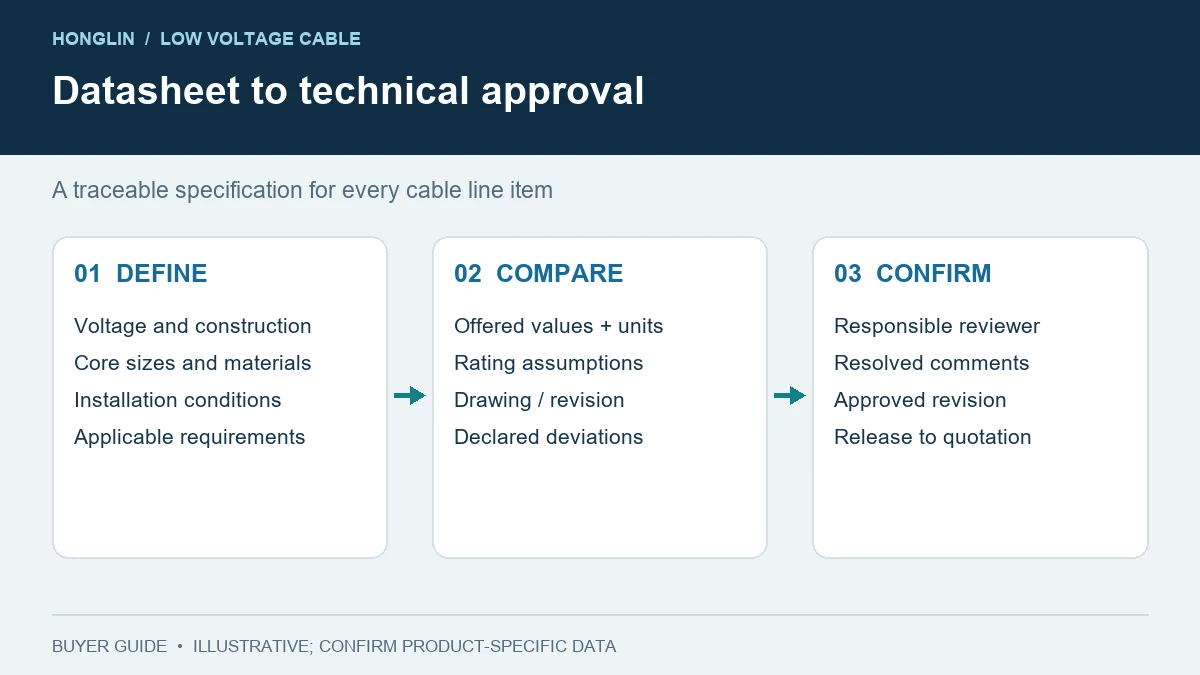
A low voltage cable datasheet should identify the cable being offered, state the conditions behind its ratings and give the project reviewer enough information to compare it with the specification. A complete low voltage cable technical submittal adds the supporting drawing, compliance schedule and relevant evidence. For an EPC buyer, the immediate objective is a traceable approval package that can also support a comparable quotation.
For 0.6/1kV power distribution projects in the Middle East, Africa, South America and Southeast Asia, begin with the actual project specification. A familiar model name or a general catalogue does not settle every construction detail. Give each BOQ item a reference and use it consistently across the offer, drawing and approval comments.
Separate the requested value from the offered value. This makes omissions visible and allows the reviewer to approve an alternative deliberately. The following worksheet is a procurement template; the supplier must complete it for the actual cable.
| Field | Information to request | Buyer check |
|---|---|---|
| Identity | Manufacturer, product reference, drawing and revision | One identifiable offer per BOQ line |
| Electrical description | Rated voltage, conductor material, core arrangement and nominal areas | Every phase, neutral and protective core specified |
| Construction | Conductor class, insulation, bedding, armour and outer sheath | Layer description matches the requested structure |
| Dimensions | Overall diameter, relevant internal dimensions, tolerances and approximate mass | Values apply to the offered size and construction |
| Rating assumptions | Installation method, ambient conditions and applicable calculation or table basis | Published current rating matches the intended assessment |
| Installation interfaces | Bending information and applicable handling or pulling instructions | Installer and accessory supplier can review compatibility |
| Requirements | Applicable standards, editions, project clauses and declared exceptions | Unsupported claims remain open, rather than marked compliant |

Manufacturer catalogues illustrate why these fields matter. For example, Nexans lists construction, marking, packaging and product standards for a specific N2XY range. Use that as an example of document structure, not as evidence for a different manufacturer's cable.
Put the project requirement in the first column, the proposed response in the second and the evidence reference in the third. Add a fourth column for deviations and questions. A statement such as “see catalogue” is difficult to approve when the catalogue contains several conductor classes, sheath materials or armour options.
The low voltage cable datasheet should be the common reference for those responses. If a supplier proposes a different core arrangement or construction, identify it as an alternative with its own document reference and price. Keep the specified offer available for comparison rather than silently substituting the cheaper option.
A low voltage cable technical submittal also benefits from an evidence index. List the documents requested by the project, their issue dates, the cable family or sample they cover and any limits of applicability. A company-level certificate and a product-specific test report answer different questions. See our guide to LV cable test reports for the procurement distinction.
A current rating without its installation conditions is incomplete purchasing information. Ask the project designer to identify the relevant route conditions, grouping, ambient or soil assumptions and protective arrangements. For the dimensional interface, obtain the proposed cable diameter before the installer finalises glands, entry plates or constrained bends.
Record which party is responsible for selecting the conductor size. A supplier can provide product data, but the review package should not leave the designer's approval responsibility implicit. Our cable sizing and voltage-drop guide explains the inputs that support a meaningful discussion.
When the low voltage cable technical submittal changes, record the reason, affected BOQ lines and the new revision. Ask whether the change affects price, accessories, drum allocation or production timing. An email approval of an earlier drawing should not be treated as approval of a later construction.
Before issuing the purchase order, cross-reference the accepted low voltage cable datasheet and list any agreed exceptions. Keep the approval record accessible to the receiving team so that the supplied labels and documents can be checked against the same definition.
Yes. Send the available BOQ and identify the missing fields. Request a conditional offer that states its assumptions, with open technical matters listed separately. Avoid treating that preliminary price as approval of an unspecified construction.
Send the form together with the referenced specification for review. The feasibility of each requirement and the evidence available must be confirmed for the offered product. A blank box should be clarified rather than filled with an unsupported compliance claim.
A range document can work if it clearly identifies each offered construction and its size-dependent values. Check that dimensions, conductor arrangements and rating conditions can be traced to each order line.
Include the BOQ, specification revision, required approval format, destination, installation information and target delivery date. These inputs help the supplier distinguish technical gaps from commercial questions.
Send Honglin Cable your BOQ or data sheet, rated voltage, core sizes, conductor material, insulation, sheath and armour requirements, lengths, destination and required documents. Identify any open approval or installation questions. Product availability, evidence, packing options and delivery terms must be confirmed for the enquiry.
Send your specification for review and quotation or browse our 0.6/1kV low voltage power cable range.