Sep. 21, 2026
An LV cable, or low voltage cable, is a power cable designed for electrical systems operating within the low-voltage range. In many international power distribution applications, LV power cables are commonly associated with rated voltages up to 1 kV, with 0.6/1 kV being one of the most widely used ratings.
LV cables are found almost everywhere electricity needs to be distributed safely and efficiently—from commercial buildings and factories to renewable energy systems, infrastructure projects, utility networks, and industrial equipment.
However, “LV cable” does not describe a single cable construction. Copper or aluminum conductors, PVC or XLPE insulation, PVC or LSZH sheaths, armor, conductor configurations, and fire-performance requirements can all vary according to the application.
This guide explains what LV cable means, how low voltage cables are constructed, the major types available, where they are used, which standards matter, and how to choose the right LV cable for a project.
LV cable stands for Low Voltage cable.
In power distribution terminology, LV cables are generally used to transmit and distribute electrical energy at relatively low system voltages. A commonly encountered LV power cable rating is 0.6/1 kV, although the exact definition and voltage classification can vary according to regional standards and application requirements.
LV cables are used downstream of transformers, switchboards, distribution panels, generators, renewable-energy systems, and other electrical equipment.
Typical applications include:
Building power distribution
Industrial plants
Commercial facilities
Infrastructure projects
Utility auxiliary systems
Renewable energy installations
Underground power distribution
Motor and equipment connections
Control and electrical equipment
A key point for buyers is that low voltage cable is a cable category rather than one specific product design.
For example, a PVC-insulated cable for an indoor installation and an XLPE-insulated armored cable for underground distribution can both be considered LV cables while having very different constructions.
The term “low voltage” can have different meanings depending on the electrical code, region, and application.
For international power-cable applications, 0.6/1 kV is a common LV cable rating. Many commercial LV power cable products are manufactured around this voltage class and are designed according to standards such as IEC 60502-1.
Some manufacturers and markets may use different voltage conventions or product classifications.
This is why buyers should avoid specifying a cable simply as “LV cable.”
A professional cable specification should normally include the actual rated voltage, such as:
0.6/1 kV LV power cable
rather than relying only on the abbreviation LV.
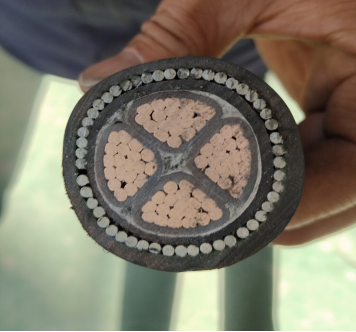
Although LV cables come in many designs, a typical low voltage power cable can contain several basic layers.
The conductor carries electrical current from the power source to the connected equipment.
The two most common conductor materials are:
Copper
Aluminum
Copper offers excellent electrical conductivity and is widely used where compact dimensions, conductivity, and mechanical properties are important.
Aluminum has lower density and can provide a cost and weight advantage for larger power-distribution cables.
Conductors may be:
Solid
Stranded
Circular
Compacted
Sector-shaped
The appropriate conductor construction depends on cable size, flexibility, installation method, current capacity, and applicable standards.
IEC 60228 is a commonly referenced international standard for cable conductors. Commercial LV cable specifications frequently combine IEC 60228 conductor requirements with IEC 60502-1 cable construction requirements.
The insulation separates the conductor from other conductive elements and prevents unwanted current flow.
Common LV cable insulation materials include:
PVC
PVC is widely used because it provides a practical combination of electrical insulation, mechanical protection, processing characteristics, and cost efficiency.
XLPE
Cross-linked polyethylene, commonly called XLPE, is widely used in power cables because it offers a higher continuous conductor operating temperature than conventional PVC insulation.
Many commercial LV XLPE cables use a 90°C conductor operating temperature under specified conditions.
Some multi-core or armored LV cables include an inner sheath or bedding layer.
This layer can help protect the insulated cores and provide a suitable surface for armor application.
Armor is not required for every LV cable.
Where mechanical protection is needed, the cable may incorporate:
Steel wire armor
Steel tape armor
Aluminum wire armor
Aluminum tape armor
Armored LV cable is often considered for underground installations, industrial environments, direct-burial applications, or locations where the cable may be exposed to mechanical stress.
The appropriate armor depends on the installation environment and applicable cable standard.
The outer sheath provides environmental and mechanical protection.
Common sheath materials include:
PVC
PE
LSZH compounds
Flame-retardant compounds
Other specialized materials
The correct sheath depends on whether the cable will be installed indoors, outdoors, underground, in a wet environment, in a high-risk fire area, or in another demanding location.
There is no single “best” LV cable.
The right product depends on the electrical system and installation conditions.
PVC insulated cable is widely used for general electrical distribution where the environmental and thermal requirements are compatible with PVC.
Typical applications include:
Building distribution
Electrical panels
General industrial wiring
Commercial facilities
Equipment connections
PVC construction is often selected when cost efficiency and conventional installation requirements are priorities.
XLPE insulated LV cable is commonly used where higher thermal performance and efficient power transmission are required.
Compared with conventional PVC insulation, XLPE can support higher conductor operating temperatures under appropriate conditions.
Typical applications include:
Industrial power distribution
Underground feeders
Commercial buildings
Infrastructure projects
Renewable energy systems
Utility distribution
Armored LV cable adds a mechanical protection layer around the insulated cable cores.
It is commonly considered for:
Underground installations
Industrial plants
Cable trenches
Direct-burial applications
Areas exposed to mechanical impact
Steel wire armored and steel tape armored designs are both used, depending on the cable construction and project requirements.
Where mechanical protection is already provided by conduit, cable tray, ducts, or other infrastructure, an unarmored LV cable may be sufficient.
Unarmored construction can reduce cable weight, diameter, and installation complexity.
Copper LV cables are commonly selected where electrical conductivity and compact conductor dimensions are important.
They are widely used in:
Buildings
Industrial equipment
Distribution boards
Control panels
Power feeders
Aluminum LV cables can be attractive for larger power-distribution systems because aluminum is significantly lighter than copper.
They are often considered for:
Large feeders
Utility distribution
Industrial power systems
Overhead and certain underground applications
The choice between copper and aluminum should consider current capacity, installation conditions, conductor size, connection technology, weight, material cost, and project specifications.
International projects often require LV cables to comply with recognized electrical standards.
One of the most important references for low-voltage power cables is IEC 60502-1, which covers power cables with extruded insulation for rated voltages up to and including 1 kV.
IEC 60228 is also commonly used for conductor requirements.
Depending on the project location and market, additional standards may include:
IEC standards
BS standards
EN standards
DIN/VDE standards
UL standards
ICEA standards
National or utility-specific standards
Commercial LV cable suppliers often manufacture different constructions according to different international standards. For example, current manufacturer product pages show LV cables designed around IEC 60502-1 and IEC 60228, while other products may be mapped to European, British, American, or customer-specific requirements.
The correct approach is to identify the project standard first and cable design second.
LV cables are used across a wide range of industries because most electrical distribution systems eventually deliver power through low-voltage networks.
LV cables can be used for:
Main distribution
Lighting circuits
HVAC systems
Elevators
Electrical equipment
Distribution boards
Modern commercial buildings may require additional fire-performance characteristics depending on local regulations and building design.
Factories often require LV cables for:
Motors
Pumps
Compressors
Production machinery
Control equipment
Distribution panels
Auxiliary power systems
Industrial environments may require additional mechanical, thermal, chemical, or flame-retardant protection.
Solar farms, battery systems, wind facilities, and other renewable-energy projects increasingly require specialized low-voltage cable systems.
Depending on the electrical architecture, LV cables may connect:
Inverters
Transformers
Switchgear
Battery systems
Auxiliary equipment
Distribution systems
The cable must be selected according to the actual DC or AC voltage, current, environmental exposure, temperature, UV requirements, and applicable standard.
LV cables are also used in:
Airports
Rail facilities
Tunnels
Hospitals
Data centers
Water-treatment facilities
Public buildings
In these applications, reliability and fire performance can be especially important.
LV cables are widely used in residential electrical distribution, although the exact cable types and permitted installations depend heavily on local electrical codes.
For residential projects, cable selection should always follow the requirements of the local authority and applicable installation standard.
One of the most important distinctions in power-cable selection is the difference between LV and MV.
LV = Low Voltage
MV = Medium Voltage
LV systems are commonly associated with voltages up to around 1 kV in IEC power-cable applications, while MV cables are designed for substantially higher distribution voltages.
The construction also becomes more complex as voltage increases.
A typical LV power cable may consist of:
Conductor → Insulation → Sheath
An armored design may add:
Conductor → Insulation → Inner Sheath → Armor → Outer Sheath
MV cable generally requires additional electrical stress-control components, including conductor and insulation screens, because the electric field becomes more critical at higher voltages.
Therefore, an LV cable should never be substituted for an MV cable simply because the cable diameter appears sufficient.
Another common source of confusion is the difference between LV power cable and extra-low-voltage (ELV) cable.
In some markets, the phrase “low voltage cable” is used for:
Alarm cables
Data cables
Access-control cables
Sensor cables
Security cables
Thermostat wiring
These applications can operate at much lower voltages than conventional LV power-distribution cables.
For power-cable buyers, it is therefore important to distinguish:
Low Voltage Power Cable
from
Extra-Low Voltage / Signal Cable
Current industry content also highlights this terminology problem because “low-voltage cable” can refer to either power-distribution cables or weak-current systems depending on the market and search context.
For an industrial power project, specifying the rated voltage and application is much clearer than using the phrase “low voltage cable” alone.
Choosing the correct LV cable requires more than selecting a conductor size.
Start with the electrical system voltage.
For example:
0.6/1 kV
is a common LV power-cable rating.
The cable's rated voltage must be appropriate for the system and comply with the project standard.
Copper is commonly selected for high conductivity and compact dimensions.
Aluminum can reduce conductor weight and may be more economical for large cross-sections.
The final choice should consider the complete installation rather than conductor price alone.
PVC and XLPE are among the most common choices.
PVC may be appropriate for conventional applications where its thermal and environmental characteristics are sufficient.
XLPE is often preferred where higher conductor operating temperature and robust power-cable performance are required.
Cable cross-section must be selected based on factors such as:
Load current
Installation method
Ambient temperature
Number of loaded conductors
Voltage drop
Short-circuit conditions
Cable length
Grouping
Regulatory requirements
A larger cable is not automatically a better cable.
Oversizing increases material and installation costs, while undersizing can create excessive heating, voltage drop, and reliability problems.
Armor should be considered when the installation exposes the cable to mechanical damage.
For underground and industrial installations, armored cable may provide valuable additional protection.
If the cable is installed inside a protected conduit or other mechanically secure system, an unarmored design may be more practical.
For buildings and public infrastructure, standard PVC may not always be sufficient.
Depending on local regulations, the project may require:
Flame-retardant cable
Low-smoke cable
LSZH cable
Low-toxicity cable
Fire-resistant cable
These terms describe different performance characteristics and should not be treated as interchangeable.
Ask where the cable will actually be installed.
Is it:
Underground?
Outdoors?
Inside a building?
In a cable tray?
In conduit?
Near heat sources?
Exposed to oil or chemicals?
Exposed to UV radiation?
Installed in a wet environment?
Environmental conditions can significantly affect cable selection.
When requesting an LV cable quotation, simply writing “1 kV LV cable” is usually not enough.
A professional RFQ should include:
Conductor material
Number of cores
Cross-sectional area
Rated voltage
Insulation material
Sheath material
Armor requirement
Applicable standard
Required cable length
Installation environment
Fire-performance requirement
Packaging requirements
For example:
4 × 120 mm² Cu XLPE/PVC 0.6/1 kV armored LV power cable, IEC 60502-1
is far more useful to a manufacturer than:
120 mm LV cable
The more complete the specification, the lower the risk of receiving an unsuitable quotation.
Depending on the manufacturer and standard, LV power cables can be supplied in many configurations.
Examples include:
Single-core LV cable
2-core LV cable
3-core LV cable
4-core LV cable
3+1 core LV cable
4+1 core LV cable
Multi-core LV cable
Copper conductor LV cable
Aluminum conductor LV cable
XLPE insulated LV cable
PVC insulated LV cable
Armored LV cable
LSZH LV cable
Large commercial and industrial cable manufacturers typically offer a broad range of conductor cross-sections and construction combinations. Published product ranges show LV cables extending from small cross-sections to very large power-distribution sizes, depending on the conductor material and cable design.
For large projects, selecting an LV cable manufacturer should involve more than comparing the price per meter.
A qualified manufacturer should understand conductor design, insulation systems, shielding or armor requirements, sheath materials, testing, and applicable standards.
Cable quality depends heavily on process control.
Important areas include:
Conductor resistance
Conductor dimensions
Insulation thickness
Sheath thickness
Electrical testing
Dimensional inspection
Finished-cable testing
Ask for the applicable standard and supporting technical documentation.
Depending on the market, customers may require:
Datasheets
Test reports
Certificates
Factory inspection
Third-party inspection
Compliance documentation
A professional cable manufacturer should be able to discuss customized:
Conductor materials
Core configurations
Cross-sections
Insulation
Sheath
Armor
Cable markings
Packaging
Cable lengths
For international projects, reliable documentation, packaging, communication, production scheduling, and delivery coordination can be just as important as the physical cable.
Honglin Cable provides LV cable solutions for customers looking for reliable electrical power-distribution products and project-specific cable configurations.
Rather than treating every LV cable as the same product, Honglin Cable focuses on matching the cable construction with the customer's actual electrical and installation requirements.
Depending on the project, customers can discuss requirements such as:
Copper or aluminum conductor
PVC or XLPE insulation
PVC or LSZH sheath
Armored or unarmored construction
Number of cores
Conductor cross-section
Rated voltage
Applicable international standard
Cable length
Packaging
Application environment
For distributors, contractors, EPC companies, electrical equipment manufacturers, and industrial users, this specification-based approach can make cable sourcing more efficient and reduce the risk of ordering a product that does not match the project's technical requirements.
LV cable means Low Voltage cable. In power-distribution applications, the term commonly refers to cables used in low-voltage electrical systems, with 0.6/1 kV being a widely used rating.
A common rating for international low-voltage power cables is 0.6/1 kV, although other ratings exist depending on the market, standard, and application.
LV cables are designed for low-voltage electrical systems, while MV cables are designed for substantially higher distribution voltages. MV cables normally require more advanced electrical insulation and field-control structures.
Not universally.
XLPE generally offers higher thermal performance, while PVC can provide a cost-effective solution for many conventional installations. The best insulation depends on the project requirements.
Yes. Aluminum is widely used in certain LV power-distribution applications, particularly where reducing cable weight and material cost is important.
No.
Armor is primarily used when additional mechanical protection is required. An unarmored cable can be suitable when the installation system already provides adequate protection.
Yes, provided that the selected cable is designed and approved for the intended underground installation.
Underground projects may require considerations such as armor, moisture resistance, sheath material, soil conditions, mechanical protection, and installation method.
IEC 60502-1 is a major international reference for power cables with extruded insulation for rated voltages up to and including 1 kV. IEC 60228 is commonly referenced for cable conductors.
The applicable standard should always be confirmed against the project specification and local regulations.
LV power cable is intended for electrical power distribution, while low-voltage signal or ELV cable may be designed for applications such as alarms, sensors, security, communication, or control.
The terminology varies between markets, so the actual voltage, application, and standard should be specified.
LV cable is not one specific cable—it is a broad category of low-voltage power-distribution cables designed for different electrical and environmental conditions.
The right product may use copper or aluminum conductors, PVC or XLPE insulation, PVC or LSZH sheathing, and armored or unarmored construction.
For a successful cable selection, buyers should begin with the actual electrical system and installation environment rather than starting with a product name.
The key questions are:
What is the system voltage?
How much current must the cable carry?
Where will the cable be installed?
Is mechanical protection required?
Which insulation and sheath material are appropriate?
Which standard must the cable comply with?
Does the project require special fire or environmental performance?
Once these requirements are established, a qualified LV cable manufacturer can recommend a suitable construction.
For customers sourcing LV cable, low voltage power cable, XLPE cable, PVC cable, armored cable, copper cable, or aluminum cable, Honglin Cable can work from the project specification to develop an appropriate cable solution.
Honglin Cable — Reliable Cable Solutions for Power Distribution, Industrial and Infrastructure Applications.