
H07RN-F outdoor selection requires more than a black rubber sheath. Confirm the offered cable's weathering, temperature and chemical-resistance evidence against the route. A standard product and an enhanced product can carry different limits even when both are called H07RN-F. This guide helps buyers specify the environment clearly and avoid converting general marketing language into an unsupported performance requirement.
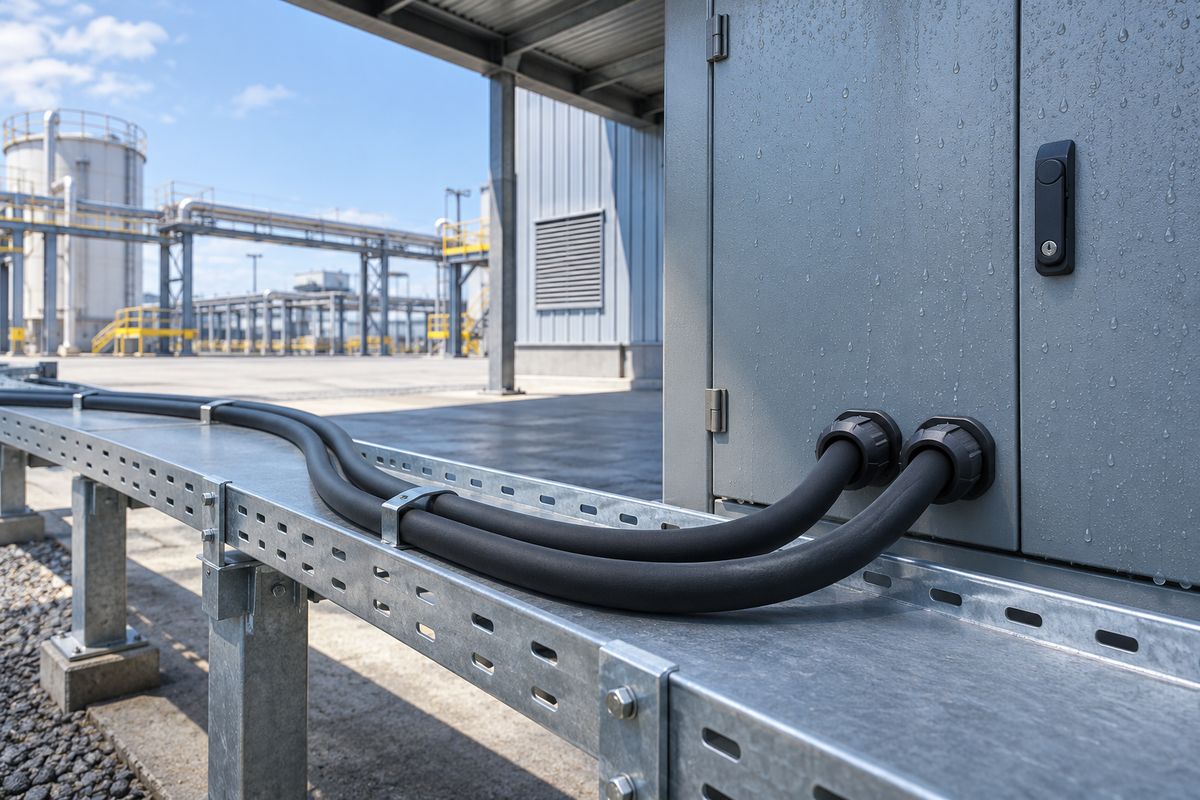
Read temperature limits in their proper context
A maximum conductor temperature is different from ambient temperature, and fixed-installation conditions can differ from mobile service. Ask which quantity each limit describes. Also identify minimum temperatures for installation and movement if the cable will be handled in cold conditions.
The LAPP standard reference gives a flexing range ending at 60°C, while Top Cable's XTREM datasheet declares a maximum conductor temperature of 90°C for its enhanced construction. These examples illustrate why the H07RN-F cable temperature rating must be checked for the actual product and service mode. They are not temperature declarations for Honglin's quoted cable. LAPP H07RN-F datasheet PDS 393807154, 1 April 2023 Top Cable XTREM H07RN-F, version 40, 29 October 2025
Specify sunlight and weather exposure
For H07RN-F outdoor power cable, describe whether the route is continuously exposed to sun, sheltered, intermittently wet or close to hot surfaces. Request the relevant weathering or UV evidence when the project requires it. A colour description or a general outdoor label is not a substitute for the specified evidence.
In hot-climate projects, distinguish ambient air temperature from heating caused by sunlight or surrounding equipment. Give the electrical designer the route conditions so the thermal evaluation uses appropriate inputs. Avoid assuming that a nominally higher-temperature cable permits a higher current through the same existing connector or enclosed assembly.
Oil resistance is specific to a test and exposure
An H07RN-F oil resistant cable request should identify the actual oil or chemical, operating temperature, contact duration and whether exposure is continuous or incidental. Different liquids and cleaning processes may require different evidence. Ask the supplier to state the test method and the scope of its claim.
Do not infer suitability for every fuel, solvent or process fluid from one oil-resistance statement. If the application includes aggressive fluids or repeated cleaning, provide their identities and request a written compatibility assessment for the offered materials. Keep this response linked to the approved construction.
Use one environment schedule for all bidders
For an H07RN-F outdoor installation, prepare a short route description with photos or a drawing where useful. Record hot and cold conditions, sun exposure, fluids, abrasion, cable support and movement. Identify whether any part can flood; continuous immersion is a separate question that should be reviewed using specific evidence.
Compare supplier responses row by row. Mark supported conditions, deviations and unanswered items, then agree the final operating envelope before ordering. This gives purchasing a clear basis for rejecting an H07RN-F outdoor substitute whose general name matches but whose environmental limits do not.
Buyer checklist
| Exposure | Question for the supplier |
|---|---|
| Sunlight and weather | What product-specific evidence supports the required exposure? |
| Hot conditions | Which temperature limit applies, and to which service mode? |
| Cold movement | What installation and movement limits apply? |
| Oil or chemicals | Which liquid, temperature, duration and test method are covered? |
| Flooding or immersion | Is the exact water duty explicitly supported? |
| Mechanical route | What bending, tension, support and abrasion conditions are permitted? |
Frequently asked questions
Is an H07RN-F UV resistant cable automatically suitable anywhere outdoors?
No. The complete environment still matters, including temperature, water, chemicals, movement and installation. Request the evidence required by the project and confirm the operating envelope.
Why do datasheets show 60°C and 90°C?
They may describe different constructions or different temperature quantities and service modes. Read the exact product document and table notes. Do not combine the most favourable figures from unrelated products.
Does oil resistant mean resistant to diesel and solvents?
Not automatically. Identify the actual substances and exposure conditions and obtain an appropriate product-specific response. A generic oil statement does not establish compatibility with every chemical.


