
H07RN-F construction site cable is commonly considered for temporary equipment power, but flexibility alone does not approve every movement pattern. Occasional repositioning, repeated dragging, festoon travel and continuous reeling impose different conditions. Buyers should describe the movement and environment before asking a supplier to confirm suitability or quote an alternative construction.
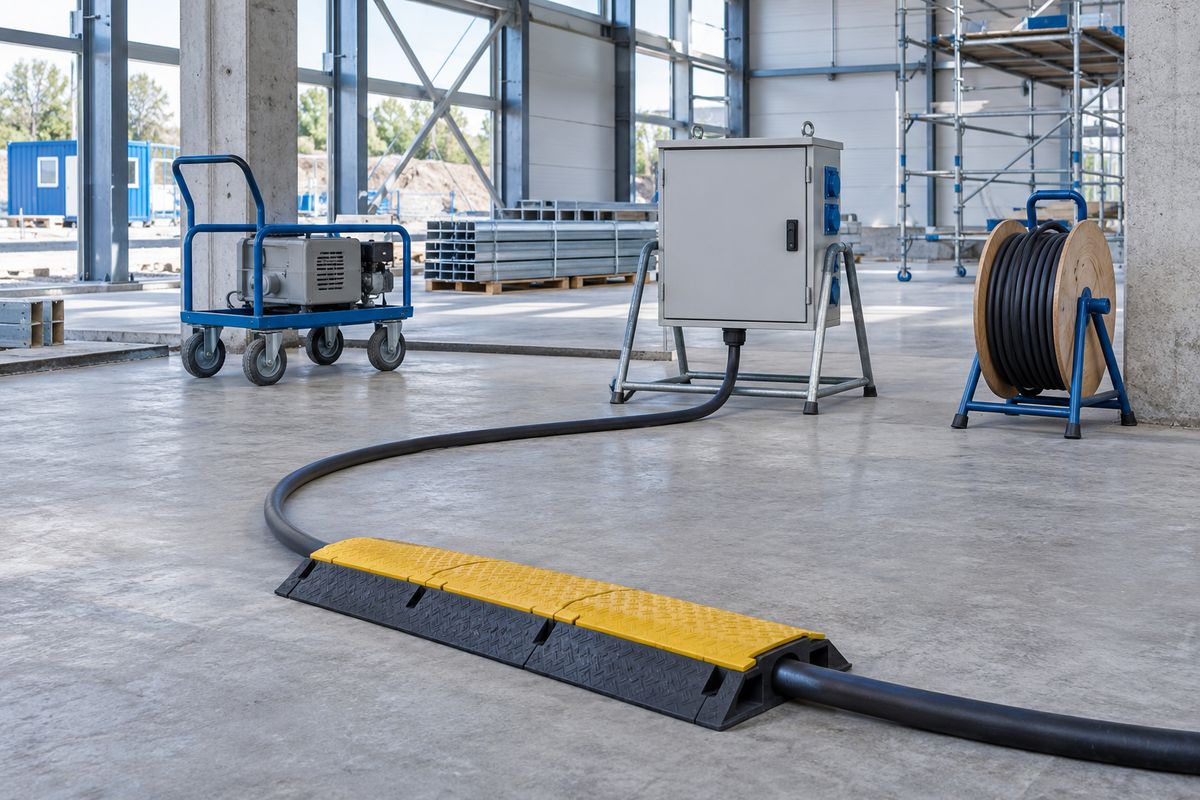
Define how the cable actually moves
Start with the equipment task: a lead laid out at the start of a shift, a mobile tool that moves occasionally, a stage supply repositioned between events or a continuously travelling machine. Record moving length, bend path, speed, acceleration, tension, torsion and expected cycles where applicable.
The H07RN-F construction site cable enquiry should separate installation handling from operating movement. A cable that tolerates a particular fixed bend may need a different radius while moving. Ask for limits tied to the exact product and service mode rather than one unqualified bending number.
Read bending and reeling data carefully
Manufacturer datasheets distinguish movement conditions. The HELUKABEL reference, for example, lists different bending guidance for fixed use, roller guidance and winding. These values apply to that product and the stated conditions; they do not establish continuous-reeling approval for every cable carrying the same family name. HELUKABEL H07RN-F, 10 April 2025
For H07RN-F cable reeling suitability, describe drum geometry, travel, tension, speed and electrical load while wound. For H07RN-F festoon cable suitability, identify suspension, loop geometry, travel and torsion. The supplier and equipment designer need these details to evaluate a complete duty rather than a generic flexible-conductor label.
Construction, stage and event power need route planning
An H07RN-F construction site cable route can encounter vehicles, debris, wet areas, heat and sharp edges. Describe protection, supports and areas where operators must handle the lead. A heavy-duty cable description does not replace routing and mechanical protection suitable for the site.
For H07RN-F stage lighting cable or H07RN-F event power cable, include connector interfaces, repeated setup, storage and lead identification. Where a venue requires specific fire-performance or approval documents, include them in the RFQ. Do not substitute a flame-retardant statement for a separately required low-smoke or halogen-free specification.
Mining and mobile equipment require application-specific review
An H07RN-F mobile equipment cable enquiry should identify whether the cable is dragged, suspended, reeled or only repositioned occasionally. Mining equipment may have additional project or regulatory requirements. Do not infer approval for a specialised mine application from a general construction-site description.
When the proposed H07RN-F construction site cable cannot support the required duty, request a different engineered construction. Record the design decision and operating limits in the purchase documentation. Agree inspection, storage and damage-response arrangements with the equipment owner so the approved cable is used within its specified conditions.
Buyer checklist
| Movement or route | Information needed for assessment |
|---|---|
| Occasional repositioning | Handling frequency, bend path and environment |
| Continuous travel | Cycles, speed, acceleration, tension and torsion |
| Reel | Drum geometry, wound load, travel and operating cycle |
| Festoon | Loop and support geometry, travel and twisting |
| Site route | Abrasion, crossings, heat, water and mechanical protection |
| Equipment interface | Connector, gland, strain relief and inspection requirements |
Frequently asked questions
Is flexible cable automatically suitable for continuous motion?
No. Conductor flexibility is only one part of movement performance. The exact cable must be assessed against the bend path, cycle pattern, speed, tension, torsion and environment.
Can I use a fixed bending radius for a moving lead?
Use the manufacturer’s limit for the relevant service mode. Fixed and moving applications may have different requirements. Provide the actual route and movement details when requesting approval.
Can H07RN-F construction site cable operate continuously on a reel?
Do not assume so. Obtain a product and reel-system assessment covering mechanical duty and electrical loading in wound and unwound conditions. A stored coil shown in an illustration is not an operating instruction.


