
Choosing between H07RN-F 5G6 and 5G10 requires the load, route length, installation conditions and protection arrangement. Both names describe five cores including a green/yellow protective conductor; the nominal area per core differs. A 10 mm² option is not automatically the right answer, and a 6 mm² option should not be approved from a plug's current label alone.
Understand the five-core arrangement
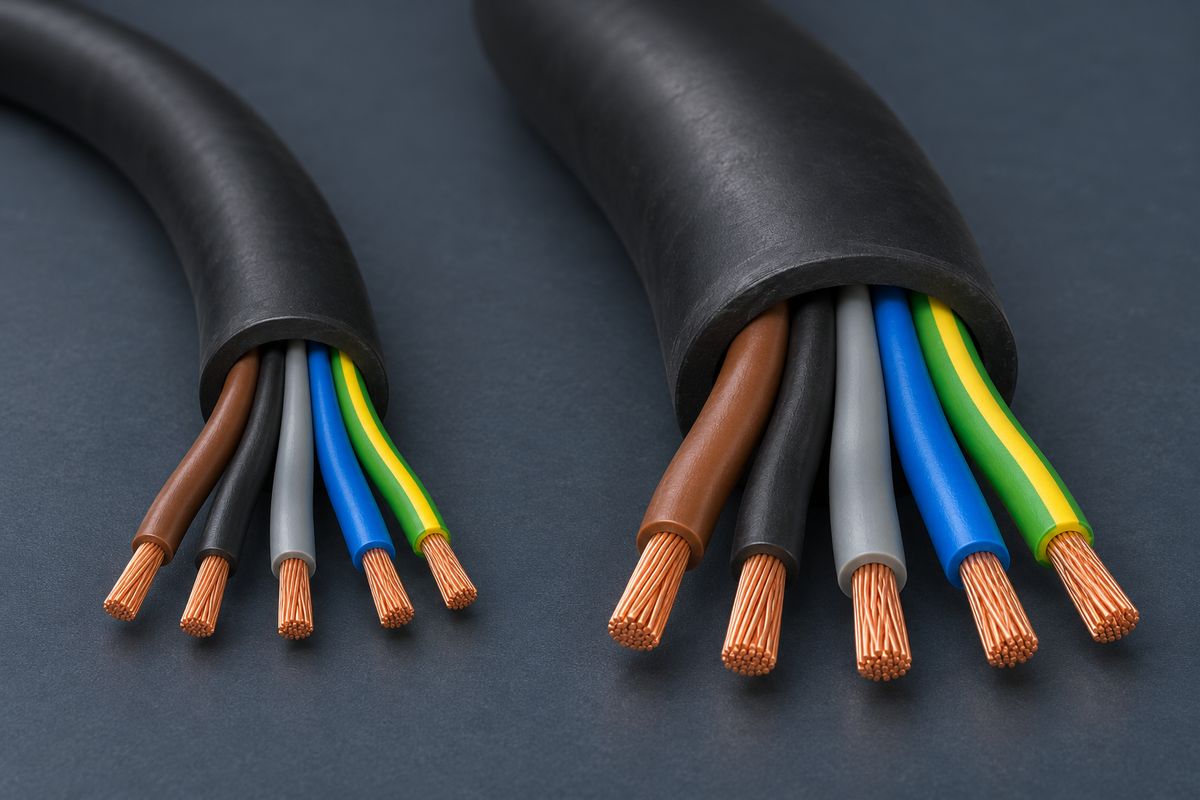
A typical five-core arrangement provides three phases, a neutral and a protective conductor. The approved circuit must confirm those functions and whether the neutral is loaded. Non-linear or unbalanced loads can affect the design assumptions; simply counting three phases is not a complete description of the thermal duty.
For H07RN-F 5G6, “6” means 6 mm² per conductor, not the outside diameter and not the total copper area. Ask for the core colour schedule and the actual outside-diameter range. Manufacturer references identify the G protective-core convention; they do not decide the installation design for the buyer. HELUKABEL H07RN-F, 10 April 2025
Compare conductor area and practical installation limits
With otherwise comparable copper construction, the larger conductor area offers lower resistance. The design must still consider the applicable current rating, voltage drop, fault protection, termination capacity and environmental conditions. A larger cable can be heavier and harder to route, especially when operators frequently move the lead.
An H07RN-F 5G6 cable price and a 5G10 quotation should therefore include more than the cable metre rate. Compare the accepted diameter, required connectors, packing and handling. A gland selected for the smaller cable may not accommodate the larger one. Do not assume that every supplier's nominally identical size has exactly the same finished diameter.
A useful selection workflow for a long route
Consider a proposed 100 m three-phase temporary supply. Before choosing a size, record supply voltage, design current, load type, starting behaviour, route configuration and the required voltage-drop limit. Provide the protection details and identify other loaded cables along the route. The designer can then evaluate candidate sizes against the same conditions.
If an H07RN-F 5G6 option fails one check, ask whether 5G10 or a different arrangement addresses the controlling issue. Increasing area alone does not fix an unsuitable water rating, an incompatible terminal or an unapproved movement duty. Record the reason for selection so purchasing can reject substitutions that undo it.
Quote the entire size schedule consistently
A project may need 5G2.5, 5G4, 5G6, 5G10 and 5G16 for different circuits. List each as a separate line with its approved length and application. Do not transfer the design decision from one circuit to another merely because both are three-phase.
For H07RN-F 5G6 procurement, attach the approved datasheet, core arrangement, test-document requirements and packing schedule. Ask the bidder to show deviations separately from compliant items. Confirm production lead time and delivery scope after the final size mix is settled; a mixed-size order can have different manufacturing or availability constraints for each line.
Buyer checklist
| Candidate | Core arrangement | Questions for technical review |
|---|---|---|
| 5G2.5 / 5G4 | 5 equal-section cores including PE | Does the load and route justify this area? |
| 5G6 | 5 × 6 mm² including PE | Current, voltage drop, neutral loading and protection |
| 5G10 | 5 × 10 mm² including PE | Same electrical checks plus larger cable handling |
| 5G16 | 5 × 16 mm² including PE | Termination, mass, bend route and approved duty |
Frequently asked questions
Is H07RN-F 5G6 always suitable for a particular plug rating?
No. A plug rating does not establish the allowable current of every cable route. Check the cable data, installation, ambient temperature, length, protection and the complete assembly.
Can I replace 5G6 with 5G10 without review?
The larger conductor may help resistance-related checks, but its dimensions, weight and terminations also change. The responsible designer should review the substitution and the supplier should confirm the offered construction.
Do I always need a neutral in a three-phase supply?
That depends on the connected equipment and circuit design. Provide the wiring diagram and intended loads. Never reinterpret the green/yellow protective core as a neutral to make a cable fit an unsuitable arrangement.


