
Jan. 10, 2026
A shielded control cable is the defensive layer that protects low-voltage control and instrumentation circuits from the electrical noise that lives on an industrial site. Buy the right one and your PLC inputs stay stable, your sensors return clean readings and commissioning is calm. Buy the wrong one and you spend weeks chasing intermittent faults. This guide explains what to check on datasheets, how to compare quotes, and which on-site choices preserve the value of your purchase.
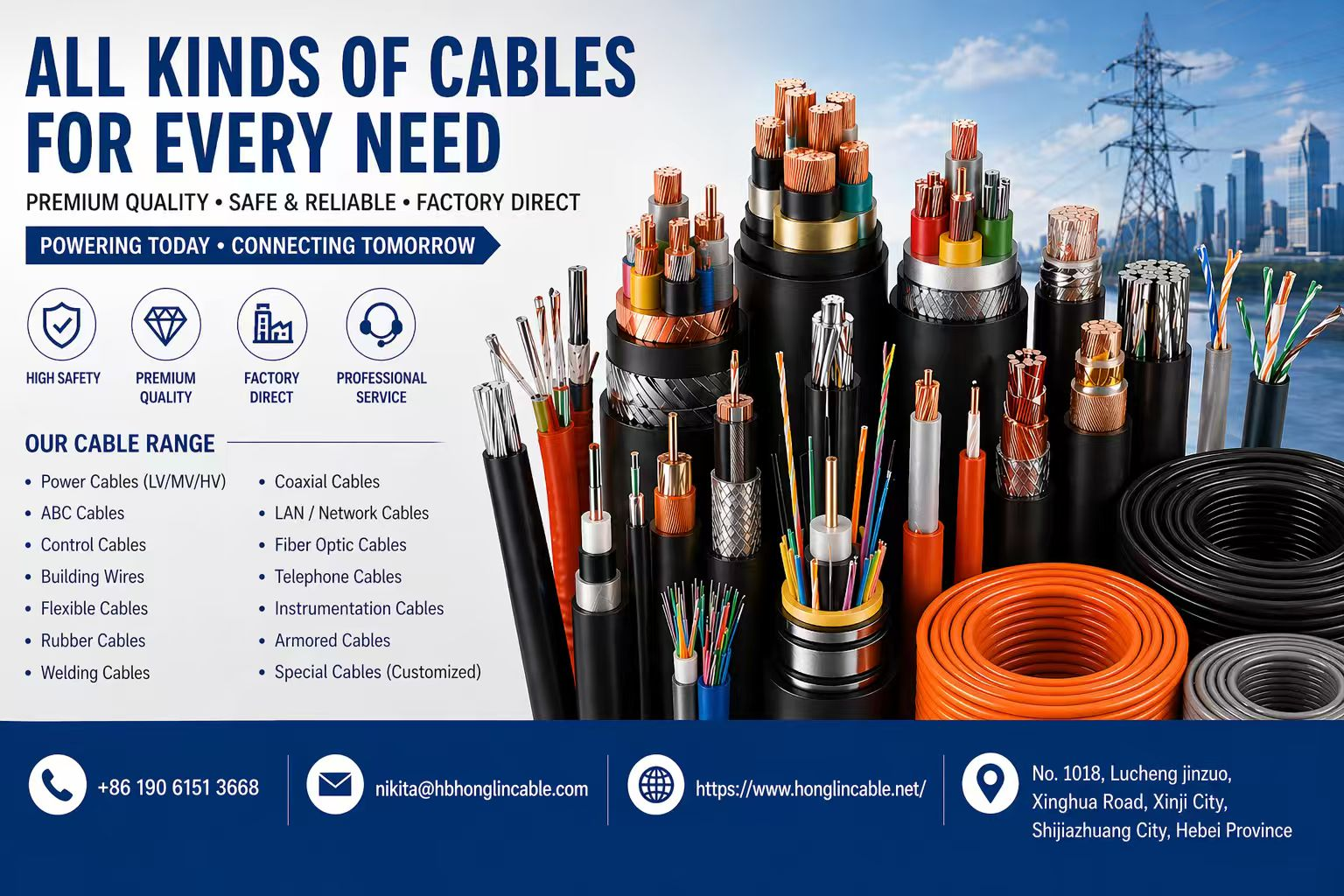
At its simplest, a shielded control cable is a multi-conductor assembly where an electrically conductive layer (foil, braid, or both) surrounds the cores to intercept and divert electromagnetic interference (EMI). The shield is normally paired with a drain conductor to make termination straightforward. Vendors describe the same functional family using terms like CY, LiYCY, Foil/Braid, or shielded tray cable; the construction details are what distinguish a mission-critical part from a cheap lookalike.
Industrial environments are full of noise sources: VFDs, welders, large motors and high-current switchgear. That noise couples into unshielded pairs and corrupts signals. A shielded control cable reduces that risk by providing a controlled, low-impedance return path for interfering currents and by physically blocking radiated fields. The result is fewer false trips, cleaner serial links, and more predictable control loops.
Foil shield (aluminum/polyester): Thin, excellent for high-frequency interference and good for twisted pairs; low profile and low cost. Often used where foil alone is sufficient.
Braid shield (tinned-copper braid): Mechanically robust and better at rejecting low-frequency fields; braid coverage (expressed as a percent) matters — higher coverage improves immunity.
Foil + braid (combined): The best of both: foil for HF, braid for LF and mechanical protection — common in VFD/servo and harsh industrial runs.
Use foil for mainly high-frequency crosstalk protection, braid where mechanical robustness and low-frequency rejection are important, and foil+braid where the run traverses mixed noise sources.
When you compare quotes for a shielded control cable, don’t stop at AWG. Insist on these datasheet fields: conductor strand count (to infer flex life), DC resistance at 20 °C (for voltage-drop calculations), shield material and percent coverage, drain-wire type and position, jacket compound and rated temperature, and minimum bend radius. Suppliers that publish these numbers make apples-to-apples comparisons possible.
Many shielded control cable parts carry 300/500 V or 600 V class ratings, and large projects demand recognized approvals (UL/CSA, VDE, IEC). If the cable runs in trays, look for TC-ER or tray-rated constructions; if it runs in plenum or egress spaces choose CMP/CL3P/LSZH variants to meet fire codes. These approvals are not optional on regulated sites and are central to both safety and acceptance testing.
A shielded control cable used for fixed panel wiring can get away with a coarser strand, but any run that flexes — pendants, robotic arms, cable carriers — needs flex-rated conductors and flex-compatible insulation. Look for explicit flex or drag-chain ratings where provided; manufacturers will often offer “flex” or “reel” variants with optimized strand counts and elastomeric compounds for continuous motion.
A shield only helps when it’s terminated correctly. Best practice for a shielded control cable is:
expose the shield only where you will connect it, fold it back neatly and secure with a properly crimped drain lug,
bond the shield/drain to earth at the recommended single point (follow the device/drive maker’s guidance to avoid ground loops), and
if paired shields are present, follow the vendor’s instructions for single-end vs. double-end termination.
Technical notes from cable and drive makers on shield termination are essential reading — they prevent the “shield made the problem worse” outcome.
Running shielded control cables directly alongside power feeders without separation or conduit — bad for immunity. Use separation or put the shielded run in its own tray.
Improper shield terminations that float both ends and create ground loops — terminate per manufacturer guidance.
Ignoring bend radii when pulling through panels and trays — stiffness and kinks ruin shields and insulation; respect the datasheet.
Include these mandatory fields in your RFQ so suppliers return comparable offers:
number of cores and AWG/mm², conductor strand count, and DCR at 20 °C;
shield type (foil, braid, foil+braid), braid percent coverage and drain conductor spec;
insulation material, jacket compound and temperature ratings;
voltage class and standards/approvals (UL, VDE, IEC, TC-ER, CMP/PLTC etc.);
minimum bend radius and flex rating (if applicable); and
packaging, sample policy and cut-length return terms.
Vendors who answer these fields transparently cut your procurement risk dramatically.

PLC I/O runs crossing motor feeders, where transient noise can flip inputs;
encoder and resolver cabling in motion control, where jitter destroys positioning;
long instrumentation runs in plant floors that pass variable frequency drives; and
security and access control installations that require reliable low-level signalling.
In each case a properly chosen shielded control cable reduces troubleshooting, eliminates spurious trips, and improves uptime.
Shielding adds cost. But the measure that matters is installed cost per operating hour. When a production line stops for a noisy-channel fault, the labour and lost throughput far exceed the modest premium for a properly specified shielded control cable. Evaluate based on replacement frequency, troubleshooting hours, and downtime exposure — not just the per-metre sticker.
For mission-critical buys request sample reels and run simple onsite tests: continuity and insulation resistance, a short flex cycle if motion is expected, and a short-term noise injection test (if practical) to verify shield effectiveness in situ. Require mill test or factory test certificates for large lots — they prove the construction you paid for.
Tinned conductors or tinned braid for marine/humid sites,
Numbered conductors or printed jackets for fast troubleshooting,
Extra spare pairs for future expansion, and
Higher braid coverage when long runs cross multiple noise sources.
Small spec choices here often pay back quickly in the field.
Treat a shielded control cable purchase as an engineering step, not a commodity buy. Require datasheets, demand sample acceptance, specify shield termination method up front, and make installation teams follow best practices on separation, bend radii and grounding. Do that and your control networks will stop being intermittent problems and start being dependable infrastructure.
Next chapter:
CY control cable — what it is and why it matters


