
Oct. 12, 2026
Quick Answer: What Is PUR Spring Cable?
PUR spring cable is a coiled electrical cable with a polyurethane (PUR) outer jacket. It is used where a retractable electrical connection is needed and the application may require flexibility and resistance to mechanical wear. Suitable designs depend on conductor construction, coil dimensions, extension length, electrical ratings, and the properties of the selected PUR material.
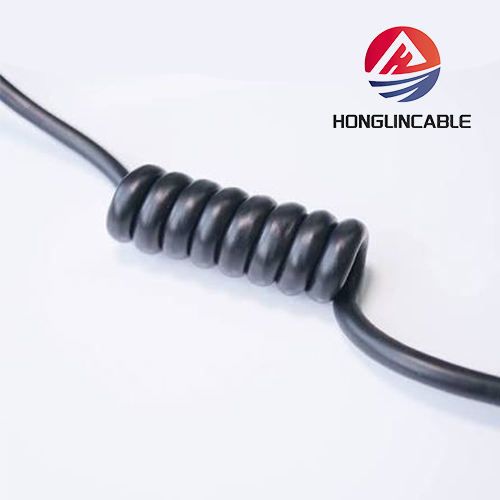
Looking for a reliable PUR spring cable for industrial equipment, automation systems, or customized electrical connections? PUR spring cables combine a coiled structure with a polyurethane outer jacket, making them a potential solution for applications that require cable flexibility, compact storage, and resistance to mechanical wear.
Also known as polyurethane coiled cables or PUR spiral cables, these products can extend when pulled and retract toward their original coiled shape when released. They are used in selected applications where equipment movement changes the distance between electrical connection points.
Choosing the right PUR spring cable requires more than selecting a jacket material. Conductor construction, coil dimensions, extension length, electrical ratings, and operating conditions all influence performance.
Honglin Cable welcomes cable-related inquiries from industrial buyers, equipment manufacturers, and OEM customers. Share your application requirements and technical specifications to discuss suitable cable options and confirm product availability.
A PUR spring cable is an electrical cable formed into a helical coil and protected by a polyurethane (PUR) outer jacket. Its coiled design allows the cable to stretch during use and retract when the pulling force is removed, helping maintain an electrical connection while reducing excess cable length.
The PUR jacket is selected for its material properties, which may include abrasion resistance, flexibility, and resistance to certain oils or chemicals, depending on the formulation.
Compared with a conventional straight cable, a PUR coiled cable can provide several practical benefits:
Compact cable management: The cable occupies less space when retracted.
Flexible movement: The coiled construction accommodates changing distances between connected components.
Mechanical protection: A suitable PUR jacket can help resist abrasion and everyday handling.
Application-specific design: Conductor size, core count, coil geometry, shielding, and connectors can be specified according to project requirements.
These benefits depend on the complete cable design. A PUR jacket alone does not guarantee suitability for every industrial environment or continuous-flexing application.
Polyurethane is commonly considered for cable applications where mechanical durability and flexibility are important. Its performance varies according to the specific PUR formulation, hardness, cable construction, temperature, and environmental exposure.
In equipment where cables contact surfaces or experience repeated handling, abrasion resistance can be an important selection factor. A suitable PUR jacket may help withstand mechanical wear during normal operation.
However, actual performance depends on the jacket grade, contact pressure, surface roughness, cable routing, and other operating conditions.
A spring cable must accommodate extension and retraction while maintaining acceptable electrical and mechanical performance.
The polyurethane jacket contributes to the cable's overall behavior, but flexibility also depends on conductor stranding, insulation material, coil dimensions, and manufacturing quality.
For equipment with frequent movement, buyers should evaluate the complete cable construction rather than relying on the jacket material alone.
Some PUR formulations offer useful resistance to oils, lubricants, and selected chemicals. This can be relevant for industrial machinery and equipment exposed to common operating fluids.
Chemical resistance is not universal. Before choosing a PUR spring cable, verify compatibility with the actual substances, concentrations, exposure duration, and operating temperature.
The spiral structure helps reduce loose cable when equipment is not fully extended. This can simplify cable management around mobile controls, adjustable equipment, and selected industrial devices.
The coil must still be designed for the required working extension and available installation space.
A properly specified PUR spring cable may support reliable service in applications that demand flexibility and mechanical wear resistance. Actual service life depends on material quality, electrical loading, extension limits, environmental exposure, and movement frequency.
Buyers should request relevant product data and testing evidence when service life is a critical requirement.
PUR and PVC are both used in coiled cable designs, but their suitability depends on the application.
| Comparison factor | PUR Spring Cable | PVC Spring Cable |
|---|---|---|
| Jacket material | Polyurethane | Polyvinyl chloride |
| Abrasion resistance | Often a key reason for selection | Depends on formulation and application |
| Flexibility | Depends on PUR grade and cable construction | Depends on PVC grade and cable construction |
| Oil and chemical resistance | Formulation-specific | Formulation-specific |
| Cost considerations | May have a higher material cost in some designs | May be economical for suitable applications |
| Typical selection priority | Applications emphasizing mechanical wear resistance | Applications with moderate demands and cost constraints |
Neither material is universally better. A PUR spring cable may be worth considering where abrasion resistance and mechanical flexibility are important, while a PVC spring cable may be adequate for less demanding conditions.
The final decision should be based on the actual operating environment, required service life, and verified material properties.
PUR coiled cables can be considered for equipment that requires a retractable electrical connection and a jacket suitable for the working environment.
Industrial equipment may use PUR spring cables to connect control panels, sensors, operating devices, and movable components. Relevant selection factors include movement frequency, cable routing, abrasion exposure, and electrical load.
Handheld controls and adjustable operating devices may require cables that extend during use and retract when the equipment returns to its resting position.
Connector compatibility, strain relief, and the required extension range are particularly important in these applications.
Selected electrical and electronic devices use coiled cables to connect components that move relative to one another. Depending on the signal requirements, the cable may need a specific conductor arrangement or electromagnetic shielding.
Some portable tools and industrial operating devices benefit from retractable cable connections. A suitable PUR jacket may be considered where cable contact, handling, or mechanical wear is a concern.
Equipment manufacturers may require a PUR spring cable with specific dimensions, connectors, core configurations, or electrical ratings.
For OEM projects, an approved drawing and detailed technical specification help align the cable design with the equipment's interface and operating requirements.
The suitability of PUR spring cable for any application should be confirmed against the actual product specifications and environmental conditions.
Before requesting a quotation, define the electrical and mechanical requirements that the cable must meet.
Provide the conductor material, cross-sectional area, number of cores, and intended electrical function. Power, control, and signal applications may require different cable constructions.
Copper is widely used in electrical cables because of its conductivity. The conductor design should also be appropriate for the expected movement and mechanical stress.
Important dimensions may include:
Relaxed cable length
Maximum required extension length
Coil diameter
Coil pitch
Straight lead length at both ends
Overall installation dimensions
These measurements help determine whether the cable can fit the equipment and cover the required working distance.
Identify the rated voltage, operating current, and any special signal or shielding requirements. The insulation system, conductor size, and overall construction must meet the electrical demands of the application.
For combined power and signal cables, specify the requirements for each circuit.
Describe the operating temperature, exposure to oils or chemicals, abrasion risk, moisture, and indoor or outdoor conditions.
For PUR materials, compatibility should be verified for the actual chemical substances and temperature range rather than assumed from the generic material name.
A spring cable should operate within its intended extension range. Excessive stretching, twisting, or poor routing can damage the cable and reduce its ability to return to the desired shape.
For frequent-movement applications, ask about the specified working range, mechanical test conditions, and available flex-life data.
If the project requires connectors, provide their part numbers, pin assignments, mounting dimensions, and wiring configuration. If electromagnetic interference is a concern, explain the signal type and installation environment so the shielding requirement can be evaluated.
Depending on the manufacturer's available product range and production capabilities, a PUR spring cable may be specified with different construction and dimensional options.
Potential specification items include:
Conductor size and number of cores
PUR jacket grade and color
Insulation material
Coil diameter and pitch
Relaxed and extended lengths
Straight lead lengths
Shielding configuration
Connector and terminal arrangement
Packaging and identification requirements
Not every option is available for every design. Customization feasibility should be confirmed after reviewing the application and technical requirements.
For Honglin Cable inquiries, customers should provide a drawing, existing sample, or specification sheet so the team can confirm whether the requested PUR spring cable is available and suitable for the project.
A reliable PUR spring cable should be evaluated against its approved product specification rather than general material claims.
Depending on the design, relevant quality checks may include:
Material verification: Confirming that the specified conductor, insulation, and PUR jacket materials are used.
Electrical testing: Performing applicable continuity, conductor resistance, insulation, or other specified tests.
Dimensional inspection: Checking coil diameter, pitch, relaxed length, extension dimensions, and lead lengths.
Mechanical evaluation: Assessing extension and recovery behavior under defined conditions where required.
Connector inspection: Verifying wiring configuration, termination quality, and compatibility with the intended equipment.
Final inspection: Checking the completed product against agreed drawings, specifications, and acceptance criteria.
Test methods and acceptance limits should be established according to the cable's intended application. Buyers should request relevant documentation when particular quality requirements are critical.
When evaluating a cable supplier, buyers should look beyond the product name and unit price. The supplier should understand the technical requirements and be able to confirm which product configurations it can actually provide.
For a PUR spring cable project, consider the following points when working with Honglin Cable:
Specification review: Share the electrical, mechanical, and environmental requirements before selecting a product.
Application matching: Confirm whether the available cable construction is appropriate for the intended equipment.
Customization assessment: Verify whether the required dimensions, material options, and connectors can be supported.
Quality documentation: Request applicable specifications, inspection records, or test reports.
Quotation clarity: Confirm order quantities, delivery expectations, packaging, and any special requirements before placing an order.
Any manufacturing capability, certification, or performance claim should be verified through current company documentation and product-specific evidence.
To help assess your PUR coiled cable requirements, prepare as much of the following information as possible:
Application and equipment description
Conductor size and number of cores
Rated voltage and operating current
PUR jacket and insulation requirements
Relaxed cable length and maximum extension length
Coil diameter and pitch
Connector details and pin configuration
Shielding requirements, if applicable
Operating temperature and environmental exposure
Estimated order quantity and delivery requirements
Technical drawings, photographs, or existing cable samples
If you do not have a complete specification, start by explaining how the cable will be used and how far it needs to extend. The missing design parameters can then be identified during the technical review.
Contact Honglin Cable to discuss your PUR spring cable requirements. Submit your drawing, product specifications, or sample details to confirm product availability, customization options, and quotation requirements.
PUR spring cable is a coiled electrical cable with a polyurethane outer jacket. It is designed for applications that require a retractable cable structure and may benefit from the mechanical properties of a suitable PUR formulation.
Depending on the material grade and cable construction, PUR coiled cable may offer abrasion resistance, flexibility, and resistance to certain oils or chemicals. Its coiled shape also helps reduce excess cable length during operation.
Not in every application. PUR may be suitable when mechanical wear resistance is important, while PVC may meet the needs of less demanding environments. The best choice depends on the exact formulation, temperature, chemical exposure, movement frequency, and budget.
Customization may include conductor size, core count, coil dimensions, extension length, jacket color, shielding, and connectors, depending on the supplier's capabilities. Confirm the available options for the specific design.
Measure the distance between the connection points at maximum extension and consider the relaxed length, coil geometry, routing path, and required movement range. The final design should remain within its specified working limits.
Some PUR formulations offer resistance to particular oils, but compatibility depends on the material grade, oil composition, temperature, and exposure duration. Verify the manufacturer's material data before use.
Provide the intended application, electrical requirements, relaxed and extended lengths, coil dimensions, connector details, and estimated quantity. Drawings or samples can help clarify the project and support a more accurate review.
PUR spring cable combines a retractable coiled structure with a polyurethane jacket that may be suitable for applications requiring flexibility and resistance to mechanical wear. Its actual performance depends on the material formulation, conductor construction, coil geometry, electrical ratings, and operating conditions.
For industrial buyers and OEM customers, selecting the right PUR coiled cable starts with a clear specification and a realistic understanding of the working environment.
Contact Honglin Cable with your application details and technical requirements to discuss available PUR spring cable options and determine the next steps for your project.


