
Nov. 16, 2026
A technical datasheet should connect the purchase specification to an identifiable construction. For a project requiring 4G95, review the conductor, insulation, inner and outer layers, dimensions and service limits together. Ask for a controlled document with a revision and an identified manufacturer.
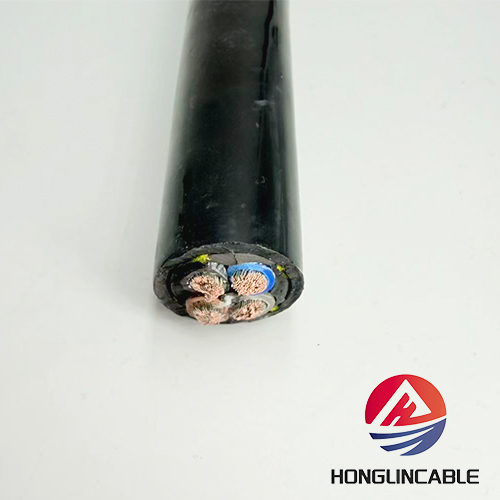
The reference documents use material grades to describe individual layers. Keep the buyer’s required grades and permitted alternatives explicit, and ask the supplier to declare which option is offered. Dimensions, mass and operating limits must come from that offered construction. Do not assemble a new datasheet from favourable numbers taken from several unrelated products.
For NSSHOEU 4x95 tinned copper cable, the conductor finish should appear explicitly in the approved material schedule. Do not infer tin coating from the colour of a catalogue image.
An NSSHOEU class 5 conductor cable requirement addresses conductor flexibility. It does not alone define whether the completed cable can withstand continuous reeling or repeated torsion.
An NSSHOEU EPR insulated cable description needs the specified insulation grade and supporting technical data. The broad polymer family is only one part of a complete material requirement.
The NSSHOEU 3GI3 insulation requirement should be written consistently in the datasheet and purchase specification. Optical character recognition can confuse letters and numbers in scanned documents.
An NSSHOEU GM1b inner sheath requirement concerns the layer beneath the outer sheath. Identify it separately so that quotations do not combine different layers under a single rubber description.
An NSSHOEU 4G95 datasheet should be specific to the offered construction and revision. Generic family information may not contain the dimensions needed for glands, handling and installation.
The NSSHOEU 4x95 tinned copper cable specification should identify conductor class, nominal cross-section, strand construction as required and the applicable electrical verification.
For NSSHOEU class 5 conductor cable, verify the conductor class in the technical documents, then assess the full cable against its intended movement and installation conditions.
For NSSHOEU EPR insulated cable, require the material designation, applicable specification and relevant electrical or ageing evidence agreed for the project.
For NSSHOEU 3GI3 insulation, use the manufacturer’s original material designation rather than inventing a new grade from an unclear scan. Record the applicable specification reference.
For NSSHOEU GM1b inner sheath, check the material schedule and cross-section drawing together. If the contract permits another specified inner-sheath option, record the selected option.
Review the NSSHOEU 4G95 datasheet for conductor finish, material layers, dimensional tolerances and stated service conditions. Obtain missing items before accepting a technical submission.
| Requirement | Information to obtain |
|---|---|
| For NSSHOEU 4x95 tinned copper cable | conductor material declaration, sample identification and the relevant resistance-test record. |
| For NSSHOEU class 5 conductor cable | conductor classification, applicable test information and separate fixed or moving-service limits. |
| For NSSHOEU EPR insulated cable | insulation designation, thickness requirements and the manufacturer’s controlled material schedule. |
| For NSSHOEU 3GI3 insulation | original material notation, insulation thickness and supporting supplier documentation. |
| For NSSHOEU GM1b inner sheath | inner-layer material, drawing identification and the agreed construction dimensions. |
| Requirement | An NSSHOEU 4G95 datasheet should identify outside diameter, approximate mass, applicable tolerances and fixed or moving-service limitations. |
Compare NSSHOEU 4x95 tinned copper cable with the exact offered construction. A bare-copper option should be recorded as a deviation when the purchaser has specified tinned copper.
Compare NSSHOEU class 5 conductor cable offers without substituting conductor class for application testing. Jacket design, core assembly and mechanical loading also matter in service.
Compare NSSHOEU EPR insulated cable proposals using the same specification. Do not treat every rubber insulation formulation as interchangeable merely because a sales description uses the same family name.
Check NSSHOEU 3GI3 insulation against the offered construction and report scope. A general rubber description is not a complete response to a named insulation-grade requirement.
Compare NSSHOEU GM1b inner sheath with any alternative inner layer through a written deviation review. Approval of an outer sheath does not automatically approve changes underneath it.
Compare each NSSHOEU 4G95 datasheet as a complete document. Do not combine one brand’s diameter with another brand’s bending radius to create an unsupported installation rule.
Outside diameter is relevant to glands and supports; mass affects handling and drum planning; bending limits depend on the service mode. Current-carrying capability requires the stated electrical loading and installation conditions. Give the responsible designer the approved product data plus ambient conditions, routing, grouping and any submerged sections. If a catalogue omits a tolerance or a limit needed for the installation, request the missing value rather than treating an approximate catalogue figure as a guaranteed dimension.
Use the manufacturer’s conductor specification and agreed inspection evidence. Check that the drawing, sample and production documents consistently identify tinned copper.
No. A reeling application needs the supplier’s specific approval for the proposed drum, bending, tension, speed and duty cycle.
Request the exact insulation designation and construction drawing. Any departure from the required material or dimensional specification should be declared before order approval.
Ask the supplier to confirm the precise grade and any deviation. The material family alone does not close every requirement on the purchase specification.
A proposed change should be disclosed and assessed against the approved specification. Record the accepted revision before production rather than relying on a verbal substitution.
A current rating must state its installation assumptions. Provide the loading, ambient conditions, grouping and heat-dissipation arrangement for an appropriate assessment.
Send Honglin your required construction, quantity, continuous lengths, operating conditions and delivery destination. Ask for a written specification response and quotation. Supply capability, test evidence and delivery arrangements must be confirmed for the actual proposed product.
Request a technical review and quotation


