
Aug. 26, 2026
What is an MV Cable?
An MV cable, or medium voltage cable, is a screened power cable designed to distribute electrical energy at medium-voltage levels. Modern MV cables typically use copper or aluminum conductors, semi-conductive conductor and insulation screens, XLPE or EPR insulation, a metallic screen, and a protective outer sheath. Common IEC voltage ratings include 6/10kV, 8.7/15kV, 12/20kV, 18/30kV and 26/35kV.
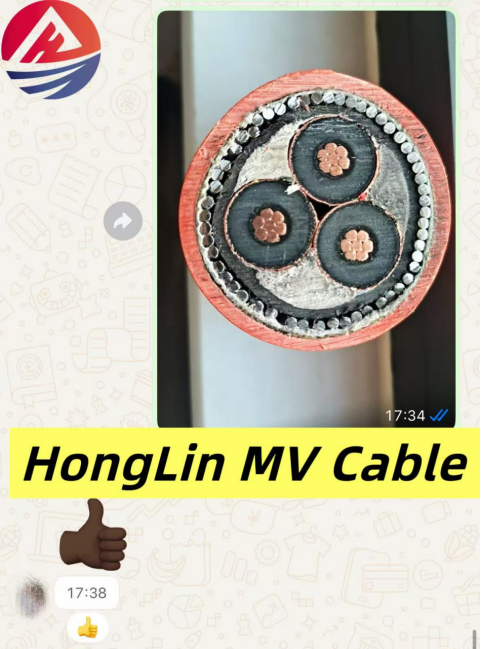
MV cable, short for medium voltage cable, is designed to transmit and distribute electrical power at medium voltage levels. It is widely used in utility distribution networks, industrial plants, substations, renewable energy projects, commercial infrastructure, mining operations, and other power-intensive facilities.
Unlike low-voltage cables, MV cables require a more sophisticated insulation and electrical stress-control system. A typical modern medium voltage cable contains a conductor, semi-conductive conductor screen, primary insulation, insulation screen, metallic screen, and protective outer sheath.
Among the available insulation technologies, XLPE-insulated MV cable is one of the most widely used solutions because of its electrical performance, thermal capability, low dielectric loss, and long-term reliability.
Depending on the project, MV cables can be manufactured with copper or aluminum conductors, single-core or three-core configurations, XLPE or other suitable insulation systems, copper tape or wire screens, and different sheath or armor constructions.
This guide explains what an MV cable is, how it is constructed, which voltage ratings are commonly used, what standards apply, where MV cables are installed, and how to select the right cable for a power distribution project.
An MV cable is a medium voltage power cable used to transmit and distribute electrical energy between substations, transformers, industrial facilities, renewable energy systems, and medium-voltage distribution networks.
Compared with LV cables, MV cables require additional layers to control electrical stress within the insulation system.
Typical MV cable construction is:
Conductor → Conductor Screen → XLPE Insulation → Insulation Screen → Metallic Screen → Outer Sheath
An armored version may contain additional mechanical protection.
The exact voltage range classified as “medium voltage” varies between standards and markets. In practical cable engineering, common MV systems include 6/10kV, 8.7/15kV, 12/20kV, 18/30kV and 26/35kV. Current commercial MV cable ranges commonly cover systems up to 35kV.
The important point is that MV cable design is determined not only by voltage, but also by insulation level, electrical stress control, screening, grounding, installation conditions and applicable standards.
There is no single worldwide voltage value that defines every MV system.
Depending on the applicable electrical standard, medium voltage can cover a range from above low-voltage systems to approximately 35kV or higher in some classifications.
For cable procurement, however, the actual system voltage and applicable standard should always be specified.
Common MV cable ratings include:
| Rated Voltage | Typical Application |
|---|---|
| 3.6/6kV | Industrial and specialized distribution |
| 6/10kV | Industrial and utility distribution |
| 8.7/15kV | Utility and urban distribution |
| 12/20kV | Distribution networks |
| 18/30kV | Utility and industrial systems |
| 26/35kV | Higher-voltage distribution and renewable projects |
Commercial MV cable manufacturers currently offer these voltage classes in copper and aluminum conductor designs with XLPE insulation and various screen/sheath configurations.
The construction of an MV cable is fundamentally different from a simple low-voltage power cable.
Each layer performs a specific electrical or mechanical function.
The conductor carries the electrical current.
The two most common conductor materials are:
Copper
Aluminum
Copper has higher electrical conductivity and can provide a smaller conductor for a given electrical requirement.
Aluminum is lighter and can offer advantages in material cost and cable weight, especially for large utility and renewable energy projects.
MV cables are commonly manufactured using stranded conductors, with conductor requirements typically referenced to IEC 60228 or the applicable national standard.
The conductor screen is an important part of MV cable construction.
It provides a smooth electrical interface between the conductor and the main insulation.
Without appropriate stress control, irregularities at the conductor surface could create localized electrical stress.
The semi-conductive screen therefore helps produce a more uniform electric field around the conductor.
This is one of the major differences between MV cable and ordinary LV power cable.
XLPE, or cross-linked polyethylene, is widely used as the primary insulation material in modern MV power cables.
Its popularity comes from several characteristics:
High dielectric strength
Low dielectric losses
Good thermal stability
Good resistance to moisture
Long-term aging performance
High continuous operating temperature
Many commercial XLPE MV cables specify a normal maximum conductor operating temperature around 90°C, with short-circuit performance determined by the applicable standard and cable design.
XLPE is not the only insulation option. EPR is also used in certain MV applications where flexibility, water resistance or other environmental characteristics are important.
However, XLPE remains a dominant technology for modern MV distribution cables.
The insulation screen is installed over the XLPE insulation.
Together with the conductor screen, it helps control the electrical field within the cable insulation system.
The insulation screen normally consists of a semi-conductive layer, often combined with a metallic screen.
This layer is essential for maintaining predictable electrical stress distribution.
The metallic screen provides several important functions.
Depending on the cable design, it can:
Provide a path for fault current
Connect the cable to the grounding system
Reduce electromagnetic interference
Maintain the electrical field around the insulation
Support safe operation during fault conditions
Common metallic screen constructions include:
Copper tape screen
Copper wire screen
Copper wire and tape combinations
Concentric neutral systems
For example, commercial IEC 60502-2 MV cables are available with copper wire or copper tape screens.
The required screen cross-section should be determined according to the system's earth-fault current and protection requirements.
For underground and outdoor MV installations, water penetration can be a significant concern.
Depending on the project, MV cable may incorporate:
Water-blocking tape
Water-blocking powder
Longitudinal water-blocking elements
Radial water barriers
The exact construction should be selected according to the installation environment and project specification.
This is particularly important for cables installed underground, in wet ducts, or in areas with a high water table.
The outer sheath protects the cable against the surrounding environment.
Common sheath materials include:
PVC
PE
MDPE
LSZH compounds
Other specialized materials
The sheath may need to provide resistance against:
Moisture
UV exposure
Abrasion
Chemicals
Soil conditions
Mechanical damage
For direct-burial applications, the sheath and complete cable construction should be selected specifically for underground conditions.
“MV cable” is a broad category rather than one specific product.
XLPE-insulated MV cable is one of the most common medium-voltage cable types.
A typical construction may be:
Cu/XLPE/CWS/PVC
or
Al/XLPE/CWS/PVC
where CWS represents copper wire screen.
XLPE MV cable is widely used in:
Utility networks
Substations
Industrial plants
Renewable energy projects
Underground distribution
Transformer connections
Commercial manufacturers offer XLPE MV cables across multiple voltage classes, including 6/10kV, 8.7/15kV, 12/20kV, 18/30kV and 26/35kV.
Copper MV cable is selected when high conductivity, compact dimensions and strong electrical performance are important.
Typical applications include:
Industrial feeders
Substations
Data centers
Power-intensive facilities
Transformer connections
Copper is generally more expensive and heavier than aluminum, but its higher conductivity can reduce conductor size.
Aluminum MV cable is widely used in utility and large-scale distribution projects.
Its principal advantages include:
Lower weight
Lower material cost
Good conductivity-to-weight ratio
Suitable performance for large conductor sizes
For long cable routes, the weight advantage can make transportation and installation easier.
Commercial MV cable ranges commonly offer both copper and aluminum conductor options.
Single-core MV cables are commonly used for high-current applications.
A three-phase system may use:
3 × single-core MV cables
rather than one three-core cable.
Single-core construction can provide advantages in:
Current carrying capacity
Installation flexibility
Large conductor sizes
High-power distribution
However, installation requires careful consideration of magnetic effects, cable spacing, bonding and screen arrangement.
Three-core MV cables contain all three phase conductors within one cable assembly.
They can simplify certain installations and are widely used in industrial and utility applications.
Typical configurations include:
3 × copper or aluminum conductors + XLPE insulation + individual screens + overall sheath
The choice between single-core and three-core construction depends on current rating, installation method, cable size, space constraints and project requirements.
Armored MV cable includes an additional mechanical protection layer.
It may be selected for:
Direct burial
Underground installations
Industrial plants
Cable trenches
Areas exposed to mechanical damage
Common armor constructions include steel tape and steel wire armor.
Not every MV installation requires armor. Where the cable is installed in a protected duct or suitable cable system, an unarmored construction may be sufficient.
Standards are one of the most important parts of MV cable procurement.
For many international MV cable applications, IEC 60502-2 is a key standard.
IEC 60502-2 covers power cables with extruded insulation for rated voltages from 1kV up to 30kV, with corresponding maximum system voltage up to 36kV.
Other standards may apply depending on the market.
Examples include:
IEC 60502-2
IEC 60228
BS standards
DIN/VDE standards
UL 1072
IEEE standards
AEIC requirements
ICEA standards
Utility-specific specifications
North American MV products, for example, may use UL 1072 and related industry specifications, while IEC markets commonly use IEC 60502-2.
Do not specify an MV cable only by saying “15kV cable.”
A professional specification should identify:
Voltage + conductor + insulation + screen + sheath + standard + installation requirements
For customers purchasing IEC-standard MV cable, IEC 60502-2 is particularly important.
A typical product specification may look like:
8.7/15kV Cu/XLPE/CWS/PVC, IEC 60502-2
This describes a medium-voltage cable with:
8.7/15kV rated voltage
Copper conductor
XLPE insulation
Copper wire screen
PVC outer sheath
IEC 60502-2 compliance
Another possible construction is:
8.7/15kV Al/XLPE/CWS/PE
The actual designation varies according to the national naming system and manufacturer.
MV cable forms an important connection between generation, transmission and low-voltage distribution systems.
Utility companies use MV cables to distribute electricity from substations to local distribution networks.
Applications include:
Underground feeders
Urban distribution
Substation connections
Distribution transformers
Ring-main networks
Large industrial facilities often require MV power to reduce distribution current and improve power-system efficiency.
MV cables may connect:
Main substations
Transformers
Large motors
Switchgear
Production facilities
Utility systems
Industries such as steel, cement, chemicals, mining and manufacturing can have substantial MV power requirements.
MV cable is increasingly important in renewable energy projects.
Solar and wind farms commonly collect electrical power from multiple generation units and deliver it to a central substation.
Typical applications include:
Solar inverter → MV transformer → MV collection network → Substation
and:
Wind turbine → Step-up transformer → MV collection system → Substation
Commercial MV cable products are specifically marketed for wind and solar farm collection systems.
Large data centers require highly reliable electrical distribution.
MV cable can be used between:
Utility connection
Main substation
Transformers
Medium-voltage switchgear
Cable selection should account for redundancy, fault levels, fire requirements and installation environment.
MV cables can also be used in:
Hospitals
Airports
Rail systems
Water-treatment plants
Large commercial complexes
Public infrastructure
Projects with critical power requirements may specify additional fire, smoke, water-blocking and mechanical-performance requirements.
Selecting an MV cable is an engineering decision, not simply a product-shopping decision.
First determine the actual system voltage.
For example:
6/10kV
8.7/15kV
12/20kV
18/30kV
26/35kV
The cable's insulation level must match the electrical system.
The required conductor size depends on the expected load.
The calculation should consider:
Continuous load
Maximum demand
Ambient temperature
Installation method
Cable grouping
Soil thermal conditions
Emergency loading
This is particularly important for MV cable.
The metallic screen and conductor must withstand the required fault current for the specified protection-clearing time.
The cable should therefore be checked for:
Thermal short-circuit withstand
and, where applicable,
Screen fault-current capacity.
Copper can be preferred where:
Space is limited
High conductivity is required
Smaller cable dimensions are valuable
High current density is important
Aluminum may be preferred where:
Long cable routes are involved
Cable weight matters
Material cost is important
Large conductor sizes are required
There is no universal winner. The correct choice depends on total project cost and engineering requirements.
Single-core MV cable is often attractive for large conductor sizes and high-current systems.
Three-core cable can provide a compact three-phase solution.
The installation method, current rating, available space and cable route should determine the choice.
The screen is not merely an optional accessory.
It plays a critical role in:
Electrical field control
Grounding
Fault-current return
Protection coordination
The screen size should be calculated according to the system fault level and grounding arrangement.
Ask:
Will the cable be mechanically exposed?
If yes, an armored design may be appropriate.
If the cable is installed inside a protected duct or suitable cable trench, unarmored construction may provide a more economical solution.
For underground applications, water blocking can significantly improve cable-system reliability.
Consider whether the project requires:
Longitudinal water blocking
Radial water protection
Water-resistant sheath
Special underground construction
For buildings and infrastructure, determine whether the project requires:
Flame retardancy
Low smoke
Halogen-free materials
Fire resistance
Special fire-performance testing
These terms describe different characteristics and should not be treated as interchangeable.
MV cable conductor sizes vary significantly according to voltage level and application.
Common conductor cross-sections include:
25 mm²
35 mm²
50 mm²
70 mm²
95 mm²
120 mm²
150 mm²
185 mm²
240 mm²
300 mm²
400 mm²
500 mm²
630 mm²
800 mm²
1000 mm² and larger for specific applications
Commercial IEC MV cable products are available in ranges such as 25–630 mm², while specialized systems can use significantly larger conductors.
However, a larger conductor does not automatically mean a better cable.
Cable size must be selected based on:
Load current + voltage drop + short-circuit requirements + installation conditions + economic considerations.
The current-carrying capacity of an MV cable depends on the complete installation system.
Important variables include:
Conductor material
Conductor cross-section
Insulation type
Ambient temperature
Cable spacing
Number of circuits
Installation depth
Soil thermal resistivity
Duct configuration
Bonding arrangement
Metallic screen losses
For underground cables, soil conditions can significantly affect thermal performance.
For single-core AC cables, the arrangement and bonding of metallic screens can also affect losses and ampacity.
Therefore, there is no universal ampacity value for an MV cable size.
The manufacturer's technical data and applicable calculation standard should be used for final design.
The fundamental difference between MV and LV cable is not simply conductor size.
MV cables require additional electrical stress-control layers.
| Feature | LV Cable | MV Cable |
|---|---|---|
| Voltage | Lower | Medium voltage |
| Main insulation | PVC/XLPE common | XLPE/EPR common |
| Conductor screen | Generally not required | Required in typical modern MV designs |
| Insulation screen | Generally not required | Required |
| Metallic screen | Application-dependent | Important part of typical construction |
| Electrical stress control | Relatively simple | Critical |
| Typical application | Building and LV distribution | Utility/industrial distribution |
A typical LV cable may be:
Cu/XLPE/PVC
while a modern MV cable may be:
Cu/XLPE/CWS/PVC
The additional screening layers are fundamental to MV cable design.
MV and HV cables are also different engineering products.
As voltage increases, electrical stress becomes more significant and cable insulation systems become increasingly sophisticated.
MV cables commonly use:
Conductor screen + XLPE insulation + insulation screen + metallic screen
Higher-voltage cable systems can require additional field-control structures, specialized insulation systems, testing procedures and accessories.
Therefore, MV cable should not be selected for an HV system simply because its insulation appears physically thick enough.
A medium-voltage cable system is only as reliable as its complete installation.
Cable accessories can include:
MV cable terminations
Straight-through joints
Separable connectors
Stress-control components
Grounding accessories
Screen bonding components
Correct installation is particularly important because an excellent MV cable can still experience premature failure if the termination or joint is improperly designed or installed.
For this reason, the cable and its accessories should be considered as one electrical system.
Quality control is critical for medium-voltage cables because defects in insulation or screening can cause serious system failures.
Depending on the applicable standard and project specification, testing may include:
Performed on production cable to verify manufacturing consistency.
Performed on selected cable samples according to the applicable standard.
Used to demonstrate that a particular cable design meets the required performance criteria.
Testing can cover parameters such as:
Conductor resistance
Voltage withstand
Insulation characteristics
Partial discharge
Dimensional characteristics
Mechanical performance
Sheath performance
For MV cable, partial discharge performance can be particularly important because localized defects in the insulation system may develop into long-term electrical failure.
A vague request such as:
“Please quote MV cable.”
is not sufficient for professional procurement.
A better RFQ might specify:
8.7/15kV, 1 × 240 mm² Al/XLPE/CWS/PE, IEC 60502-2, underground installation
This provides the manufacturer with essential information about:
Voltage
Core configuration
Conductor size
Conductor material
Insulation
Screen
Sheath
Standard
Installation
A complete MV cable RFQ should ideally include:
Rated voltage
Number of cores
Conductor material
Cross-sectional area
Insulation material
Metallic screen
Armor
Outer sheath
Installation method
Short-circuit current
Applicable standard
Required length
Testing requirements
Packaging/drum requirements
The more complete the specification, the more accurate the quotation and engineering review will be.
Honglin Cable provides power cable solutions for customers requiring medium voltage cable for utility, industrial, infrastructure and renewable energy applications.
For MV projects, cable selection should be based on the complete electrical and installation specification rather than a generic product name.
Honglin Cable can develop the cable configuration around project requirements such as:
MV system voltage
Copper or aluminum conductor
Single-core or three-core construction
XLPE insulation
Copper tape or wire screen
PVC, PE or LSZH sheath
Armored or unarmored construction
Water-blocking requirements
Applicable IEC or national standard
Cable length and drum configuration
This specification-based approach is suitable for:
EPC contractors
Utility projects
Electrical contractors
Power distributors
Renewable energy developers
Industrial plants
Infrastructure projects
Cable distributors
Electrical equipment manufacturers
For an MV cable quotation, providing the system voltage, conductor size, installation method, fault level, cable length and required standard allows Honglin Cable to recommend a much more accurate cable construction.
An MV cable is a medium-voltage power cable designed for electrical power distribution between substations, transformers, industrial facilities, utility networks and other medium-voltage systems.
MV stands for Medium Voltage.
XLPE is one of the most widely used insulation materials for modern MV power cables. EPR is also used for certain applications.
For many IEC-based applications, IEC 60502-2 is the principal standard for power cables with extruded insulation in the relevant medium-voltage range. Other markets may use standards such as UL, IEEE, AEIC, ICEA, BS or DIN/VDE.
Common ratings include 6/10kV, 8.7/15kV, 12/20kV, 18/30kV and 26/35kV.
Yes. Copper is widely used for MV cables where high conductivity and compact dimensions are important.
Yes. Aluminum MV cable is widely used in utility distribution, renewable energy and other applications where lower weight and material cost are advantageous.
The conductor and insulation screens help control electrical stress, while the metallic screen also provides grounding and a path for fault current according to the system design.
Neither material is universally better.
XLPE provides excellent electrical and thermal performance and is widely used in utility and industrial distribution.
EPR can be advantageous in applications requiring flexibility, moisture resistance or specific thermal characteristics.
The appropriate insulation depends on the project.
Not necessarily.
Armor depends on the installation environment and mechanical protection requirements.
Yes. Underground installation is one of the major applications for MV cable.
The cable should be specifically selected for burial conditions, including mechanical loading, moisture, soil thermal properties and water protection.
A single-core MV cable contains one conductor and is typically installed as three separate cables for a three-phase system.
A three-core MV cable contains all three phase conductors in one cable assembly.
The choice depends on current rating, installation method, cable size, space and project economics.
Service life depends on cable design, insulation quality, operating temperature, installation conditions, electrical loading, moisture exposure and maintenance.
A professionally designed and correctly installed MV cable system can provide decades of service, but service life should not be promised without considering the actual operating conditions.
MV cable is a critical part of modern electrical distribution infrastructure.
Unlike ordinary low-voltage cable, a medium-voltage cable must control electrical stress throughout the insulation system.
That is why a typical modern MV cable includes:
Conductor → Conductor Screen → XLPE Insulation → Insulation Screen → Metallic Screen → Outer Sheath
The correct cable depends on far more than voltage.
Engineers and buyers should evaluate:
System voltage
Load current
Conductor material
Conductor cross-section
Single-core or three-core construction
XLPE or EPR insulation
Metallic screen
Short-circuit current
Armor requirements
Water protection
Sheath material
Installation environment
Applicable standard
Cable accessories
Testing requirements
For companies sourcing MV cable, medium voltage power cable, XLPE MV cable, IEC 60502-2 cable, 6/10kV cable, 8.7/15kV cable, 12/20kV cable, 18/30kV cable or 26/35kV cable, Honglin Cable can provide cable solutions based on the project's electrical and installation requirements.
Honglin Cable — Medium Voltage Cable Solutions for Reliable Power Distribution.


