Mar. 16, 2026
If your fleet runs pumps, conveyors, shuttle cars, cutters or mobile substations, choosing the right multi-core MYP rubber cable for mining machinery is one of the smartest reliability investments you can make. This guide gives procurement and engineering teams a practical, copy-ready approach to specifying, sourcing and accepting cables that actually survive the abuse underground and on site: the exact construction fields to demand, the mechanical and electrical tests that prove performance, the installation and handling practices that preserve life, and the contract language that prevents surprises.
A failed cable stops equipment immediately; a failed cable in a confined or wet environment risks safety and long production outages. The multi-core MYP rubber cable for mining machinery is a purpose-built product: fine-stranded copper conductors for flex fatigue resistance, elastomeric insulation for dielectric stability, semiconducting layers for field control, and a heavy elastomer jacket engineered for abrasion, oil and impact resistance. When these elements are specified numerically and tested, you get reliability. When they’re left as marketing phrases, you get surprises.
High-ranking supply pages and datasheets that win business do three things well:
Provide numeric values, not adjectives (strand count, mm insulation thickness, jacket mm, Taber abrasion cycles).
Publish sample per-reel test certificates (insulation resistance, DC resistance, hipot) and show how reel lot numbers map to certificates.
Include procurement fields (MOQ, lead time, termination options, packaging photos).
When you ask suppliers for a multi-core MYP rubber cable for mining machinery, demand the same transparency you see on winning supplier pages.
Use these exact construction fields in your RFQ so manufacturers must answer with numbers:
Rated voltage U₀/U (e.g., 0.66/1.14 kV).
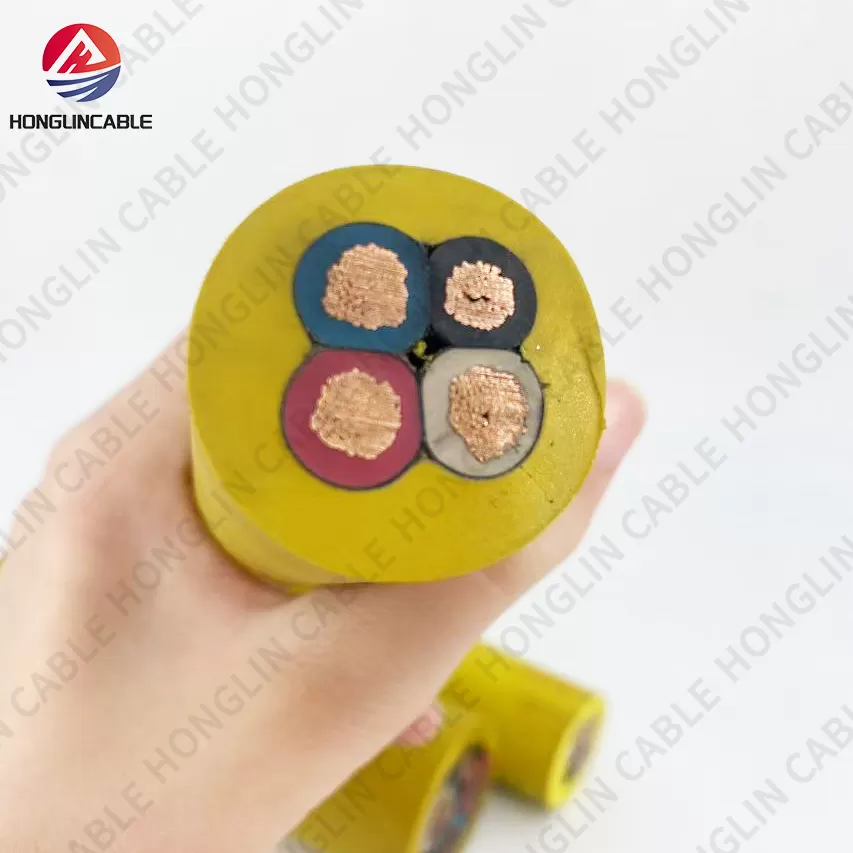
Core configuration (e.g., 3 × 95 mm² + 1 × 50 mm² earth) and exact conductor strand count per core (e.g., 1333 strands).
Conductor material and tinning (annealed copper, tinned copper for wet/corrosive service).
Insulation material and thickness per core (compound name and mm).
Inner/outer semiconducting layer description.
Metallic screen/armor details (braid %, concentric earth dimensions, armor type and coverage).
Water-blocking method (gel, swellable tape, sealed core) and hydrostatic/immersion test numbers.
Outer jacket compound name, minimum thickness (mm), Taber abrasion cycles to endpoint, tear strength (N/mm), and oil-swell % for your site fluids.
Mechanical ratings: minimum static and dynamic bend radius (×OD), recommended drum ID for reeling, puncture/crush force (N) and impact energy (J).
Marking & traceability: printed part number and unique lot/serial on reel or length.
Asking for these ensures the supplier can’t hide differences behind “heavy duty” or “mining grade.”
Objective, per-reel evidence is how you avoid costly failures. Require the following:
Per-reel insulation resistance (MΩ) and test temperature; record date and inspector.
Per-reel conductor DC resistance (Ω/km) measured and compared to table values.
Dielectric/hipot test value (kV) and test duration for each reel or for sampled reels from the same lot.
Flex/reeling life: cycles-to-failure or pass-at-N-cycles tested at the drum ID you will use (lab drum results at small diameters overstate life).
Abrasion resistance: Taber cycles or equivalent with endpoint definition; report the test method.
Puncture/crush/impact numbers expressed as Newtons or Joules.
Hydrostatic/immersion tests for pump leads with post-test insulation resistance.
Oil/chemical compatibility tests against the exact fluids used on site (hydraulic oil grade, diesel, solvents).
Material MSDS and polymer grade sheets for jacket/insulation.
Per-reel traceability: each physical reel must match a test pack with the same lot/serial.
Per-reel paperwork converts supplier claims into enforceable acceptance criteria.
Supplier to quote multi-core MYP rubber cable for mining machinery — U₀/U = [specify], configuration [cores × mm²], conductor strand count [n], conductor tinning (yes/no). Provide full datasheet and per-reel certificates including insulation resistance (MΩ), conductor DC resistance (Ω/km) and dielectric/hipot (kV). Flex/reeling life test must be reported at drum ID = [mm]. Taber abrasion cycles, puncture/crush numbers and oil/chemical compatibility tests for [list site fluids] are required. Each reel/length shall be printed with part/lot serial and shipped with a weatherproof test pack. Include lead time, MOQ and termination options (plain/terminated) and packaging photos.
Vendors that provide numeric answers and attach sample certificates are serious candidates; vague replies mean more risk.
Practical choices must balance cost and life:
Strand count vs cost: higher strand counts (many fine wires) dramatically improve flex life for reeling applications. For continuous reeling choose finer-stranded conductors.
Jacket chemistry: PUR/TPU for sliding abrasion; CPE/neoprene for oil + abrasion balance; specialized thermoset elastomers for extreme cold or chemical exposure. Match compound to your fluid tests.
Water-blocking: gel fill is excellent for pump leads; swellable tapes are lighter and work for short wet runs. For long submersion demand sealed or gel designs.
Armor: increases crush and impact resistance but increases bend radius and reduces flexibility — use only where needed.
A good supplier will present measured data for each variant so you can choose using numbers.
Even perfect cable fails if mishandled. Enforce these site rules:
Respect minimum dynamic bend radius and the supplier’s recommended drum ID when reeling. Smaller drums and tight bends shorten life.
Use broad-faced rollers and smooth guides at change-of-direction points; protect edges with polymer guards.
Control spooling and pulling tension; avoid snatch pulls and kinks.
Apply sacrificial spiral wrap at predictable wear zones.
Prefer factory terminations for pump leads and medium-voltage jumpers; factory terminations have consistent sealing and potting.
On arrival, perform a quick inspection: match reel lot to test pack; measure insulation resistance and DC resistance on a sample length; visually inspect jacket for voids and extrusion defects.
Make final acceptance conditional on matching certificates and buyer spot checks — don’t accept paperwork later.

Terminations and splices are where most field failures begin:
When possible, avoid in-line splices by ordering correct lengths or manufacturer-terminated assemblies.
If splices are necessary, use factory-recommended kits and trained technicians; document every splice and add pop-test or hipot records to the maintenance file.
For wet or submersible terminations ensure glands, boots and potting compounds are chemistry-matched to the jacket. Mismatched accessories are the most common cause of water ingress.
Factory-terminated assemblies simplify warranty and reduce accidental damage.
Managing cables like assets reduces emergency work:
Record reel lot/serial, install location and reeling cycles or hours in your CMMS.
Trend insulation resistance at critical terminations monthly. Declining values often precede failure.
Maintain lot-matched spares for critical feeders to avoid mixing batches with different compounds or strand counts.
Plan replacement before the vendor fatigue cycles are reached in critical reeling circuits.
A modest inventory of matched spares significantly reduces downtime risk.
Protect yourself with clear contractual clauses:
Per-reel acceptance: final acceptance conditioned on per-reel test packs matching the printed lot and passing buyer spot checks.
Replacement and remediation: supplier replaces out-of-spec reels at supplier cost within X days.
Warranty: supplier warrants material free from manufacturing defects for Y months or Z operating hours; remedies limited to reel replacement and reasonable replacement labour if pre-agreed.
Records retention: supplier retains production/test logs for each lot for at least three years and provides them on reasonable request.
Contract language like this turns supplier claims into enforceable obligations.
Accepting family test reports instead of per-reel certificates — insist on per-reel evidence.
Ignoring strand count — ask for exact strand numbers, not “flexible conductor.”
Failing to require flex tests at your drum ID — lab drum data is often not representative.
Mixing lots on critical feeders — keep lot-matched spares.
Using too small drum diameters to save space — this shortens cable life dramatically.
Avoid these traps and the multi-core MYP rubber cable for mining machinery you buy will be an asset, not a liability.
The difference between a cable that lasts months and one that lasts years is measured, repeatable data: strand count, insulation thickness, jacket chemistry, flex cycles at your drum ID and per-reel certificates. Specify the numbers, demand per-reel traceability and enforce handling discipline. When you do, the multi-core MYP rubber cable for mining machinery you buy will protect uptime, reduce maintenance and make life on the floor a lot less reactive.