Apr. 14, 2026
When buyers search for an industrial control cable supplier, they are usually not looking for theory. They are trying to solve a practical problem: how to keep machines, panels, and automation systems running with stable wiring that can stand up to daily industrial use. In that sense, the cable is not a small accessory. It is part of the system’s reliability, and it affects installation quality, maintenance effort, and long-term operating cost. Pages from major industrial cable suppliers consistently frame control cable around automation, instrumentation, measurement, control, and regulation, which confirms that this is a purchase driven by performance rather than appearance.
A strong industrial control cable supplier should be able to do more than offer a product list. The supplier needs to understand the conditions where the cable will actually work: inside a control cabinet, alongside a PLC, near motors or drives, across machine frames, or in environments that demand repeated routing and dependable signal transfer. The reason the first page is full of manufacturer and supplier pages is simple: industrial buyers want a source that can match cable construction to the application. They want stable supply, technical clarity, and products built for real operating conditions.
A capable industrial control cable supplier should also offer a wide enough product range to cover different project needs. Some buyers need unscreened control cable for general panel work. Others need shielded versions for signal integrity. Others need armoured structures, flame-retardant options, or flexible builds for moving equipment and compact routing. Guda’s control cable page, Eland’s control cable category, and Shentai’s control cable pages all reflect this market pattern: the right cable depends on shielding type, conductor class, route protection, and industrial application.
In control cabinets, neatness matters. A panel that is organized is easier to inspect, easier to troubleshoot, and easier to expand later. That is why an industrial control cable supplier should understand not only the electrical side of the job, but also the physical layout of wiring. If the cable routes cleanly and terminates properly, the installer saves time, and the maintenance team gains confidence later. Industrial automation suppliers such as IEWC and Beckhoff emphasize easy routing, repetitive movement resistance, and efficient field cabling because these qualities make real installation work simpler.
Noise resistance is another major buying factor. In industrial systems, cables often run near sources of interference, and weak wiring can create unstable signals or unnecessary troubleshooting work. That is why shielded control cable is so common in automation and process control. Eland explicitly ties control cables to signal transmission, measurement, control, and regulation, while Guda highlights stable transmission and noise resistance for PLC panels and instrumentation circuits. A good industrial control cable supplier understands that the cable must protect the signal as much as it carries it.
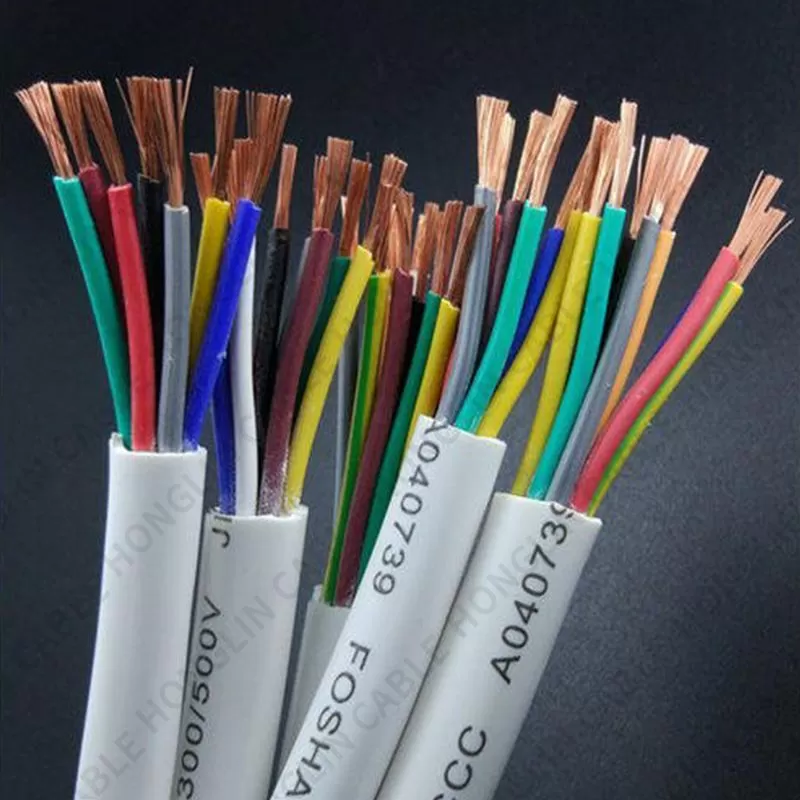
Construction quality is what separates a dependable cable from a troublesome one. Fine-stranded conductors support flexibility. Proper insulation supports electrical reliability. A durable jacket supports wear resistance. Shielding supports cleaner transmission. Many product pages in this category emphasize flexible routing, harsh environment performance, and industrial automation use because those are the real reasons buyers choose one cable over another. A serious industrial control cable supplier does not sell wire as a commodity only; it sells a construction that helps the buyer avoid costly failures later.
This is also why customization matters. One project may need a standard control core. Another may need a screened cable. Another may require a specific jacket material or a special structure for machine building, robotics, or process plant installation. Supplier pages from Hesheng, Shentai, and Eland show that industrial customers increasingly expect application-specific solutions rather than one universal format. A dependable industrial control cable supplier should be able to recommend the right structure instead of forcing every buyer into the same choice.
A good industrial control cable supplier also makes project execution faster. In manufacturing and automation, delays are expensive. If the wiring is wrong, the job stops. If the cable is unsuitable, the system may need to be reworked. That is why industrial buyers value suppliers that provide clear product guidance and reliable availability. Molex and IEWC both present industrial automation cabling as a way to support machine builders and system integrators with flexible options and dependable operation in rugged environments.
For control panel builders, repeatability is crucial. The same specification may be used across several projects or product lines, so the supply source must stay consistent. An industrial control cable supplier that can deliver stable quality from batch to batch becomes part of the customer’s own production process. This is one reason the homepage results favor manufacturers and established suppliers with clear production capability, certifications, and long industry experience. Buyers are not only purchasing a product. They are purchasing continuity.
Maintenance is another place where cable choice shows its value. When technicians need to inspect a cabinet, trace a fault, or replace a line, clear and dependable wiring saves time. A well-chosen control cable supports easier diagnosis and less stress during service. That is why the best industrial control cable supplier should think beyond the sale itself. The supplier should help the buyer reduce future downtime, simplify inspections, and keep the equipment easier to work on over its full service life.
Industrial environments can be demanding. Vibration, abrasion, heat, moisture, and repeated movement all place stress on cables. A supplier that understands those conditions can recommend products that are better matched to the worksite. IEWC emphasizes flexible routing and harsh environmental conditions, while Guda highlights route protection for process plants and utility environments. This confirms a simple point: the buyer needs an industrial control cable supplier that understands the difference between a cable that merely meets a specification and one that survives real production use.

The commercial value is easy to understand. A cheaper cable that fails early can create larger costs in labor, stoppage, and troubleshooting. A better cable may cost more at purchase, but it can reduce those hidden expenses later. That is why industrial buyers often judge an industrial control cable supplier by total value rather than unit price alone. Supplier pages that stress quality, reliability, and industrial suitability are responding to this exact buying behavior.
For OEMs, distributors, and panel shops, the ideal supplier relationship is long-term. The buyer needs a source that can support repeated orders, technical questions, and different project requirements without losing consistency. A good industrial control cable supplier helps standardize procurement, reduce sourcing risk, and keep future builds aligned with the original specification. That kind of reliability is one of the most valuable things a supplier can offer, especially in industrial automation where downtime has real business consequences.
The market results show a clear pattern: buyers want industrial application knowledge, not vague generalities. They want control cable suited to automation, measurement, signal transmission, PLC panels, machine wiring, and control cabinets. They also want products that can be routed easily and used in rugged environments. An industrial control cable supplier who can answer those needs clearly stands a much better chance of winning trust than a supplier who only talks about price.
That is why the right industrial control cable supplier becomes part of the project’s success. The supplier helps choose the right structure, support the right installation method, and reduce the risk of later failure. In practical terms, that means cleaner panels, more stable signals, easier maintenance, and better long-term value for the buyer. In industrial work, that is exactly what a good supply partner should deliver.
A final point is that industrial buyers increasingly expect both technical depth and responsiveness. They want a supplier that can explain shielded versus unshielded options, flexible versus fixed use, and standard versus custom structures without wasting time. A strong industrial control cable supplier does more than quote a product. It helps the buyer make a confident decision for the equipment, the panel, and the operating environment. That is what turns a simple cable purchase into a dependable industrial solution