Dec. 09, 2025
When you search for 3 0 welding cable you’re usually solving the same three problems: deliver enough current for stable arcs, survive repeated reeling and rough handling, and protect terminations so they don’t become hot spots. The right purchase eliminates emergency replacements, shortens setup time and keeps crews welding instead of waiting. This article explains how to choose, inspect and maintain the best 3 0 welding cable for your fleet or shop so each reel becomes a long-lived asset rather than a recurring expense.
A 3 0 welding cable sits in the sweet spot between large bulk conductors and portable leads. It supports high welding currents at short to moderate runs while remaining manageable on reels and in tool storage. For mobile welders, maintenance crews and small fabrication shops this size provides strong current-carrying capability without the bulk of larger gauges — which is why many operations standardize on 3 0 welding cable for stingers, grounds and generator jumpers.
The phrase 3 0 welding cable tells you gauge but not how the cable was built. Two products listed with the same name may differ widely if one is a fine-strand Class K rope-lay with an EPDM jacket and the other is a coarse strand with thin PVC. Always require a datasheet that lists strand count, DC resistance at 20 °C, jacket compound and minimum bend radius before you compare per-foot prices.
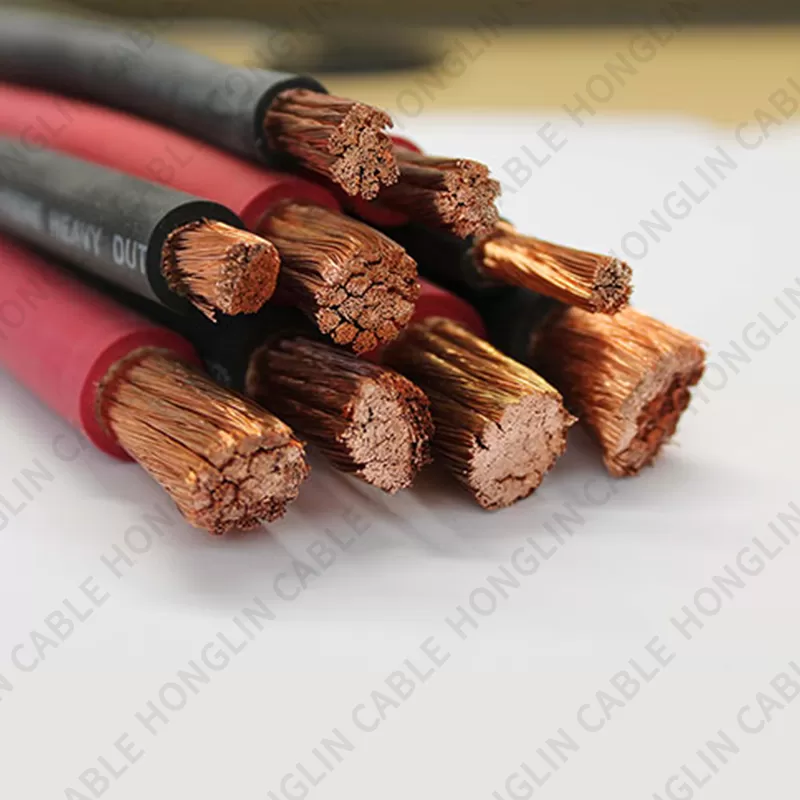
When you evaluate any 3 0 welding cable, the conductor’s strand geometry should be your first technical filter. A rope-lay or high-strand construction (often >1500 filaments for 3/0) distributes bending stress across many tiny wires, producing vastly better flex life than coarse strand builds. In practice this means cleaner crimps, fewer broken strands at lugs, and far longer service when cables are unspooled and rewound daily. If your leads are handled heavily, strand count is a cost-saving spec, not a luxury.
The jacket is the cable’s armor. For heavy-duty use choose EPDM or neoprene over basic PVC: elastomeric jackets remain flexible at low temperatures, resist oils and fuels, and tolerate abrasion and UV far better than commodity jacketing. If your 3 0 welding cable lives on service trucks or in outdoor yards, the modest premium for an EPDM jacket is usually repaid quickly in fewer replacements and less downtime.
A 3 0 welding cable has good nominal ampacity, but long runs and pulsed welding currents still require calculation. Use the cable’s DC resistance to compute round-trip voltage drop at expected peak and average welding currents. Welding machines produce short high current pulses — model both surge and continuous cases. If the computed end-voltage is marginal, either increase conductor size or shorten the run; neither problem is solved by buying a cheaper 3 0 welding cable.

In the field, terminations are the weak link. To make sure your 3 0 welding cable assemblies are reliable:
choose compression lugs sized to the conductor and stud, ensuring the lug barrel fully captures the strand bundle,
crimp with tooling specified by the lug maker and verify the mechanical hold,
use heat-shrink and a strain-relief boot so bending stresses aren’t concentrated at the crimp, and
commission critical joints with a thermal scan under load to detect high-resistance spots early.
Factory-terminated leads are a sensible option if you lack calibrated crimp tools — the convenience premium often costs less than repeated field rework.
How crews handle cable determines life expectancy more than brand. For every 3 0 welding cable you own, enforce these simple rules:
use reels with drum diameters that respect the cable’s minimum bend radius,
protect pass-through edges with smooth grommets to prevent chafing,
clean jackets before rewinding to remove grit and metal filings that abrade the sheath, and
rotate reel use so wear distributes evenly across inventory.
These low-cost practices dramatically increase mean time between failures and improve safety.
A properly specified 3 0 welding cable is commonly used for:
stinger and ground leads for 200–300 A welding machines,
generator hookup and temporary power distribution at work sites,
battery bank interconnects and inverter feeds in mobile power systems, and
feeder leads for portable motors and compressors.
For each use case select jacket chemistry and strand geometry to match expected abrasion, chemical exposure and flex frequency.
When duty is severe, consider these upgrades for your 3 0 welding cable:
tinned conductors for marine or corrosive atmospheres, which protect strand surfaces,
ultra-flex constructions with very high strand counts for rental fleets and robotic cells, and
specialty jackets (flame-retardant, low-smoke, chemical-resistant) when site conditions or regulations require them.
These features increase upfront cost but frequently lower whole-life expense by reducing replacements and unscheduled labour.
Per-foot pricing is only the start. Convert the sticker into installed cost by factoring in termination labour, expected replacement intervals, and downtime costs. In many operations a modestly higher per-foot cost for a fine-strand, EPDM-jacketed 3 0 welding cable yields a lower cost per operating hour than a cheap PVC, coarse-strand alternative.
To collect comparable quotes for 3 0 welding cable, include these mandatory fields in your RFQ:
conductor construction: exact strand count and filament diameter,
DC resistance at 20 °C (Ω per unit length) and any ampacity/duty charts,
jacket chemistry, insulation thickness and rated temperature range,
minimum bend radius and outside diameter, and
packaging/form factor (cut-length vs spool vs pre-terminated) plus required test certificates (mill test, insulation resistance, hipot).
A precise RFQ forces vendors to disclose the numbers that matter and prevents surprise substitutions.
Teach crews a 60-second pre-use routine for every 3 0 welding cable:
visually inspect the jacket full length for cuts, flattening or exposed strands,
confirm lugs are fully seated and strain relief is fitted, and
look for discoloration near terminations that suggests prior overheating.
A quick check prevents the majority of field failures and improves site safety.
A short, repeatable maintenance program keeps leads reliable:
log reel IDs and batch numbers for traceability and warranty handling,
clean and inspect jackets after heavy use,
thermal-scan critical terminations during commissioning and periodically, and
retire any cable with exposed conductors or deep jacket damage immediately.
Consistent care turns each 3 0 welding cable into a dependable, long-lived tool.
When you buy a 3 0 welding cable, treat the purchase as an engineering decision: require strand geometry for flex life, choose jacket chemistry to match exposure, demand DC resistance and temperature ratings on the datasheet, and ensure terminations are performed and verified by trained staff. Require sample reels for mission-critical orders so crews can validate flexibility and crimp behaviour under real handling before large commitments. Do these things once and your 3 0 welding cable will be a durable, safe and cost-effective part of your equipment fleet — exactly the outcome every operations manager wants.
Previous post:
3 awg welding cable — why this choice matters on the job