Dec. 04, 2025
If you’re looking for a dependable 25mm welding cable, this guide walks you through the hard numbers and the practical choices that separate a short-lived purchase from a long-serving investment. Below you’ll find clear, buyer-first advice on conductor construction, jacket selection, voltage-drop math, termination best practices and procurement checklists tailored to contractors, fleet managers and workshop owners.
A 25mm welding cable is a common choice where moderate to high welding current is required but extreme bulk isn’t practical. It’s often used for generator hookups, stinger and ground leads on 200–300 A machines, battery interconnects and short feeder runs. When you search for a 25mm welding cable, think of it as a performance tool — one that must combine current capacity with flexibility, reliable terminations and resistance to the workplace environment.
The label “25mm” tells you cross-sectional area but not how the cable was made. Two cables with the same 25mm marking may behave very differently. Always ask vendors for:
strand count and filament diameter (predicts flex life),
DC resistance at 20 °C (for voltage-drop calculations),
jacket chemistry and rated temperature range, and
minimum bend radius and outer diameter for reel planning.
Insist on a datasheet before you compare per-metre prices — that’s the only way to get apples-to-apples quotes for 25mm welding cable.
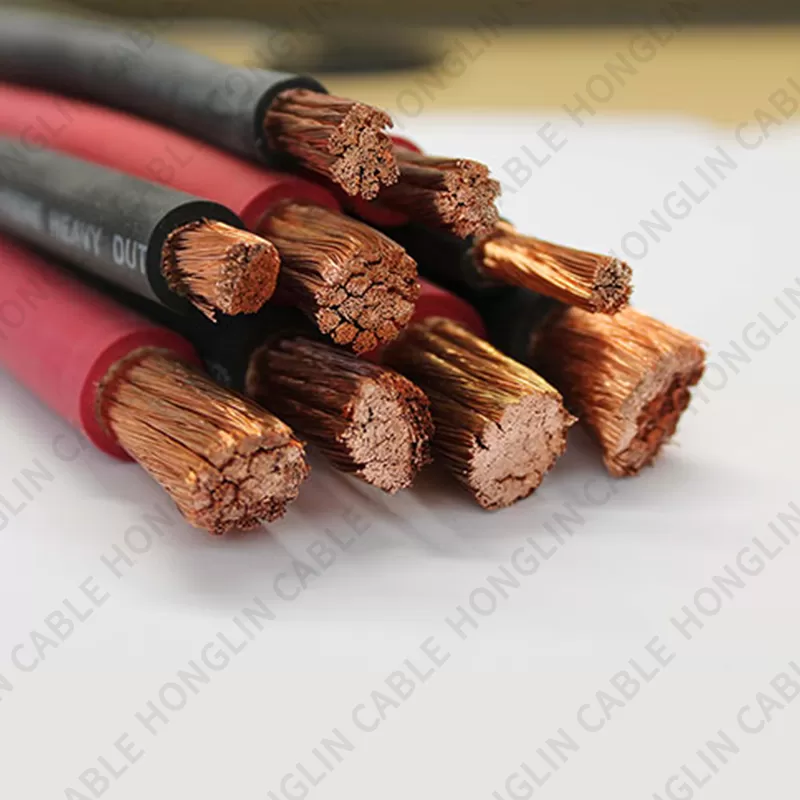
For real-world service, conductor stranding is the biggest single predictor of lifetime. A 25mm welding cable built from many fine filaments (rope-lay or high-strand bunch) flexes far more cycles than a coarse-stranded alternative. Benefits of fine-strand construction:
much longer flex life on reels and in mobile use,
crimp terminations that hold better and present fewer stray wires, and
reduced risk of local strand breakage at bends and lug barrels.
If your leads are unspooled daily — rental fleets, service trucks, or busy shop reels — ask for strand count and filament size when evaluating 25mm welding cable offers.

The jacket is the armor for your 25mm welding cable. For industrial, outdoor or vehicle-mounted use prefer elastomeric jackets (EPDM or neoprene) over plain PVC. Elastomeric jackets:
remain flexible in cold weather,
resist oils, battery acid and ozone, and
tolerate abrasion and sunlight better than commodity PVC.
A modest premium for an EPDM-jacketed 25mm welding cable typically returns lower replacement rate and less unplanned downtime.
A properly specified 25mm welding cable can carry substantial current, but run length and duty matter. Use the manufacturer’s DC resistance to compute round-trip voltage drop at expected peak and continuous welding currents. Welding machines see short, high current pulses; model both surge and average loads. If end-voltage is marginal, upgrade conductor size or shorten the run — these fixes are cheaper than repeated rework from poor arc stability.
Most field failures happen at the termination, not mid-span. For long life from any 25mm welding cable:
choose compression lugs sized to accept the entire strand bundle,
crimp with the tooling recommended by the lug manufacturer and verify the mechanical hold,
fit heat-shrink and strain relief to avoid bending stress concentrating at the crimp, and
perform a thermal check under load during commissioning to catch high-resistance joints early.
If you lack certified crimp tooling, factory-terminated leads can be a cost-effective alternative despite a higher per-metre price.
Per-metre convenience is great for small repairs: many suppliers sell 25mm welding cable by the metre for quick cut-lengths. For fleet outfitting or large projects, spools deliver a far lower per-metre cost. Pre-terminated assemblies cost more but save labour and remove termination quality risk. When you compare listings for 25mm welding cable, normalize pricing to the same spec set (strand count, jacket, DCR) and treat factory assemblies as a separate SKU.
How crews treat cable makes a huge difference:
use reels sized to respect minimum bend radius,
protect pass-through edges with smooth grommets or chamfers,
clean jackets of grit before rewinding, and
rotate reel usage so wear is distributed evenly.
These simple operational changes turn a good 25mm welding cable into a durable asset and cut replacement frequency dramatically.
Common uses for 25mm welding cable include:
short stinger and ground leads for 200–300 A welding machines,
generator hookup and temporary site distribution,
battery bank interconnects for energy systems, and
feeder leads for portable motors and compressors.
For each application, set your jacket and strand requirements to the mechanical and environmental stresses expected.
Consider these upgrades when duty is heavy or environments are aggressive:
tinned strands for marine or corrosive atmospheres,
ultra-flex constructions with exceptionally high strand counts for rental fleets, and
specialty jackets (flame-retardant, low-smoke) where safety or regulation demands them.
The upfront cost rises, but these features often lower whole-life cost by reducing failures and emergency labour for replacements of 25mm welding cable.
When requesting quotes for 25mm welding cable, include these mandatory items:
exact conductor construction (strand count and filament gauge),
DC resistance at 20 °C and ampacity/duty guidance,
jacket chemistry, insulation thickness and rated temperatures,
minimum bend radius, outside diameter and packaging options, and
test certificates (mill test, insulation resistance, hipot) and sample acceptance policy.
A strict RFQ forces suppliers to provide the true numbers you need and prevents low-spec substitutions.
Teach crews a 60-second pre-use routine for every length of 25mm welding cable:
scan the jacket full length for cuts, gouges or flattening,
verify lug seating and strain relief, and
look for discoloration or softening that could indicate prior overheating.
Add a short thermal scan of critical terminations during commissioning and periodically thereafter — it catches most hidden high-resistance joints before they fail.
When you choose a 25mm welding cable, define the duty first and then shop for the best value that meets it. Demand datasheets, insist on termination quality, and train crews in handling and inspection. Do those things and the 25mm welding cable you buy will deliver stable arcs, fewer failures and the lowest installed cost per operating hour — the practical outcome every procurement manager wants.