Dec. 01, 2025
When you specify a 2 0 ofc welding cable, you’re choosing a lead that combines a heavy conductor area with oxygen-free copper purity to reduce resistive loss and improve joint reliability. That combination matters in applications where voltage drop, heat at terminations and long-term reliability are not negotiable. A well-built 2 0 ofc welding cable doesn’t just transmit current — it delivers consistent arc performance, minimizes maintenance interventions, and tolerates the real-world abuse of reels, engines and workshops.
Oxygen-free copper reduces the risk of localized conductivity variations and improves corrosion resistance at terminations. In a 2 0 ofc welding cable, the higher purity copper helps keep DC resistance low and stable, which means less voltage drop across the lead and cleaner arc behaviour at the weld. For battery interconnects and inverter feeds the difference shows up as better starting performance and fewer hot spots under heavy cycling. If your operation depends on predictable results, OFC in a 2/0 conductor is a measurable upgrade.
Labeling a product 2 0 ofc welding cable gives you cross-section and conductor material, but it omits the details that drive real performance: strand count, filament gauge, jacket chemistry, DC resistance at 20 °C, rated voltage and minimum bend radius. Two cables both called 2 0 ofc welding cable can behave very differently if one uses a rope-lay of many fine filaments and an EPDM jacket, while another uses coarse strands with a thin PVC sheath. Always request the datasheet and compare those numbers before you order.
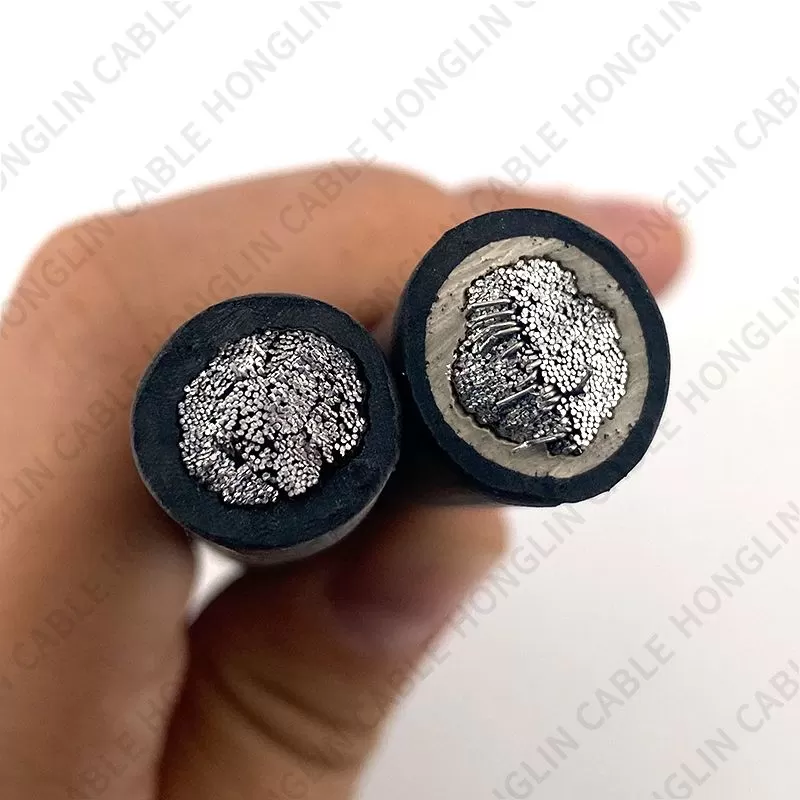
Practical crews know that flex life is the number that matters. For a 2 0 ofc welding cable, rope-lay or bunch-stranded conductors made of many fine filaments (typically 30 AWG-class filaments) deliver far more flex cycles than coarse strands. Advantages include:
higher fatigue resistance when the lead is reeled and unreeled repeatedly,
cleaner compression in crimp lugs with fewer stray strands, and
lower likelihood of localized strand fracture at bends and terminations.
If reels, rental fleets or daily handling are part of your workflow, choose a 2 0 ofc welding cable with a published strand count and “flex” class.
The jacket is the cable’s armor. For a 2 0 ofc welding cable that lives in workshops, engine rooms or open yards, an EPDM or neoprene elastomer jacket vastly outperforms basic PVC. Elastomeric jackets remain flexible in cold, resist oil and ozone, and tolerate abrasion and sunlight — qualities that translate directly into fewer replacements and lower lifecycle cost. Specify jacket chemistry and temperature rating on your RFQ so suppliers don’t substitute a cheaper PVC option.
Before you place a purchase order for a 2 0 ofc welding cable, insist on these published values:
conductor construction: strand count and filament diameter,
DC resistance at 20 °C (Ω per 1000 ft or Ω per m),
rated voltage (commonly 600 V for welding cable) and operating temperature range, and
minimum bend radius and nominal outer diameter.
With these figures you can calculate voltage drop, check thermal limits, and plan reel and conduit clearances.
A 2 0 ofc welding cable offers strong ampacity, but run length and welding duty decide whether it’s the right choice. Use the supplier’s DC resistance figure to compute round-trip voltage drop at expected peak and average welding currents. Welding presents high short peaks; if your end-voltage is marginal, step up the conductor size or shorten the run rather than accept unstable arc performance. Correct sizing preserves weld quality and prevents stressed equipment.
In practice, most cable failures appear at the joint, not mid-span. To get the best from a 2 0 ofc welding cable:
use compression lugs sized for the conductor and stud, ensuring the lug barrel captures all strands,
crimp with the manufacturer-specified dies and tooling, and verify mechanically where possible,
install heat-shrink and strain-relief boots so bending forces aren’t concentrated at the lug, and
commission critical terminations with a thermal scan under load to detect marginal high-resistance points.
A properly made joint preserves the low resistance advantages of OFC and prevents dangerous heating.
How crews manage reels dramatically influences life expectancy. For every 2 0 ofc welding cable you own:
choose reels with a drum diameter that respects the minimum bend radius,
protect pass-through edges with grommets to prevent chafing,
clean jackets before rewinding to avoid embedding grit that abrades the sheath, and
rotate use across reels so wear is distributed evenly.
These low-effort routines pay back in fewer failures and less downtime.

A 2 0 ofc welding cable is commonly used for:
portable welding leads for heavy fabrication and field repairs,
battery interconnects and inverter feeds in mobile power systems,
generator hookup and temporary distribution for construction sites, and
stingers and whips in production welding cells.
In each case, match jacket chemistry and strand geometry to the expected mechanical and environmental stress.
Per-foot price is the initial metric, but whole-life cost tells the real story. A 2 0 ofc welding cable with high-strand geometry and an EPDM jacket costs more upfront than a cheap PVC alternative — but it typically outlasts the cheap option by a large margin, reducing replacements, labour for re-termination, and downtime. When budgeting, convert per-metre quotes into installed cost per operating hour to make a fair comparison.
There are scenarios where additional investment pays off:
tinned OFC conductors for marine or corrosive atmospheres to protect strand ends,
ultra-flex constructions with extremely high strand counts for rental fleets and robotic cells with millions of cycles, and
flame-retardant or low-smoke jackets where site rules or safety codes demand them.
A modest premium for the right 2 0 ofc welding cable reduces replacement frequency and operational risk in demanding contexts.
To get apples-to-apples quotes for 2 0 ofc welding cable, include the following mandatory fields:
conductor construction: strand count and filament gauge;
DC resistance @ 20 °C and ampacity/duty charts;
jacket chemistry and rated temperature range;
minimum bend radius, outer diameter and packaging (spool vs pre-cut); and
required test certificates (mill test, insulation resistance, hipot) and sample acceptance policy.
A tight RFQ forces suppliers to provide the actual numbers you need to make a confident technical and commercial decision.
Adopt a short maintenance regimen:
visually inspect jackets and terminations before each job,
thermally scan critical terminations during commissioning and after heavy use,
remove any cable with exposed strands or deep cuts immediately, and
log reel IDs and batch numbers for traceability and warranty claims.
A little routine care extends the service life of every 2 0 ofc welding cable you own.
Don’t buy based on cross-section alone — demand strand count and DCR.
If you lack certified crimp tooling, consider factory-terminated leads for critical joints.
For fleet outfitting, buy reels rather than short cuts to lower per-metre cost.
Match jacket chemistry to exposure — EPDM for oily, cold or abrasive sites.
These simple precautions prevent expensive reorders and safety headaches.
When you order a 2 0 ofc welding cable, treat the purchase as systems engineering: specify conductor geometry for flex life, select a jacket suited to your environment, require DC resistance and temperature ratings on the datasheet, request a sample reel for mission-critical deployments, and insist on professional termination and inspection. Do that and your 2/0 OFC leads will be dependable, safe and economical to operate — saving time, money and frustration on every job.